


"I AM RUNNING OUT OF MONEY!..." Your alimony payments have suddenly stopped, and panic is setting in. But what if you had planned for this possibility? Could alimony insurance have helped?
For over 20 years, I have helped women ease their financial burden during and after a divorce. I've heard many stories, and some of the most heartbreaking involve an ex-spouse who dies or becomes disabled, leaving a family financially vulnerable.
Too often, the problem is a lack of financial protection built into the divorce plan.
Result?
Economic hardship and colossal stress. Please don't risk it!
In this post, you'll learn how alimony insurance works, when you might need it, and what to consider before putting coverage in place.
Curious?
Alimony Insurance and Why My Neighbor Lost Her Hair

First, let me tell you the story of my neighbor Sarah and how she lost her beautiful hair.
I met Sarah and her husband, Mike, five years ago. She was a pretty woman in her early 40s with gorgeous red hair.
Life was beautiful for Sarah: beach-front house, two kids in private school, Mike's successful career, and happy marriage. Or so she thought.
One day, Sarah found out about Mike's infidelity. Going through emotional turmoil, she filed for a divorce. Fortunately, Sarah received a favorable divorce settlement.
Two years later, Sarah got terrible news: "You've got cancer."
Soon after, Mike died in an accident. Her alimony payments stopped, but fortunately, their divorce agreement required a life insurance policy to secure those payments.
Remember Sarah's gorgeous red hair?
She was terrified to lose it because of chemo. She heard about the cold caps, a protocol to prevent hair loss. At that time, it was $600 a session out of pocket, but Sarah was confident everything would be fine.
A few days after scheduling chemo, she got a call from the insurance company telling her that the alimony insurance policy had lapsed.
A few days after scheduling chemo, Sarah learned that the life insurance policy intended to protect her alimony payments had lapsed.
THE LESSON
An insurance requirement in a divorce agreement is not the same as an active insurance policy.
Imagine!
Sadly, there are many women like Sarah. Some lost their home and moved to a smaller place or relocated. Others had to take their children out of private school or, like Sarah, give up additional care they could no longer afford.
Particularly hard is the loss of alimony for older women.
As for Sarah, she's doing well now. I helped her find a way to generate income.
What's the moral of the story?
To start, let's ask the question,
"What the heck is alimony insurance?"
What is Alimony Insurance Policy?

Alimony Insurance Basics
If you're confused about insurance during divorce, you're not alone. And with so many financial decisions already on your plate, insurance may be the last thing you want to think about. But before you dismiss it, let's cover a few basics.
Life or disability Insurance

Alimony insurance isn't a separate type of insurance policy. It is generally life insurance used to protect alimony payments if the paying ex-spouse dies. Disability insurance may provide additional protection in case of illness or injury. The insured is the ex-spouse who pays alimony.
End of alimony payments
In Florida, certain alimony obligations end when either former spouse dies. Life insurance can provide financial protection if your ex-spouse dies while the policy is still in force.
Alimony Insurance by Court Order

In Florida, like in some other states, a court may require life insurance to secure alimony payments when special circumstances justify that protection.
Source: Florida Statutes §61.08(4)
Why do courts do this?
Because losing alimony can turn your financial world upside down. Think of life insurance as a security blanket for your alimony payments. You hope you'll never need it, but you'll be glad it's there if you do.
In the 2025 Florida case Zargari v. Zargari, an appeals court reversed a $500,000 life insurance requirement because the judgment lacked the necessary findings to justify it.
The lesson? Court-ordered life insurance isn't automatic. Special circumstances must justify the requirement, and the court must consider the availability and cost of coverage.
And what about child support?
That's another financial obligation worth protecting. In Florida, courts may also require life insurance to secure child support payments under certain circumstances. But child support and alimony are separate obligations, with different legal considerations.
Is there an alternative to alimony insurance?
Yes. I will cover it in a later chapter.
The next logical question is, "What should you know about insurance in divorce vs. marriage?"
KEY TAKEAWAY: If your ex-spouse dies, your alimony payments may stop. A properly structured life insurance policy can help protect your financial future.
Lesson 1: Avoid Common Insurance Mistakes
First, here are some common insurance mistakes you should avoid.
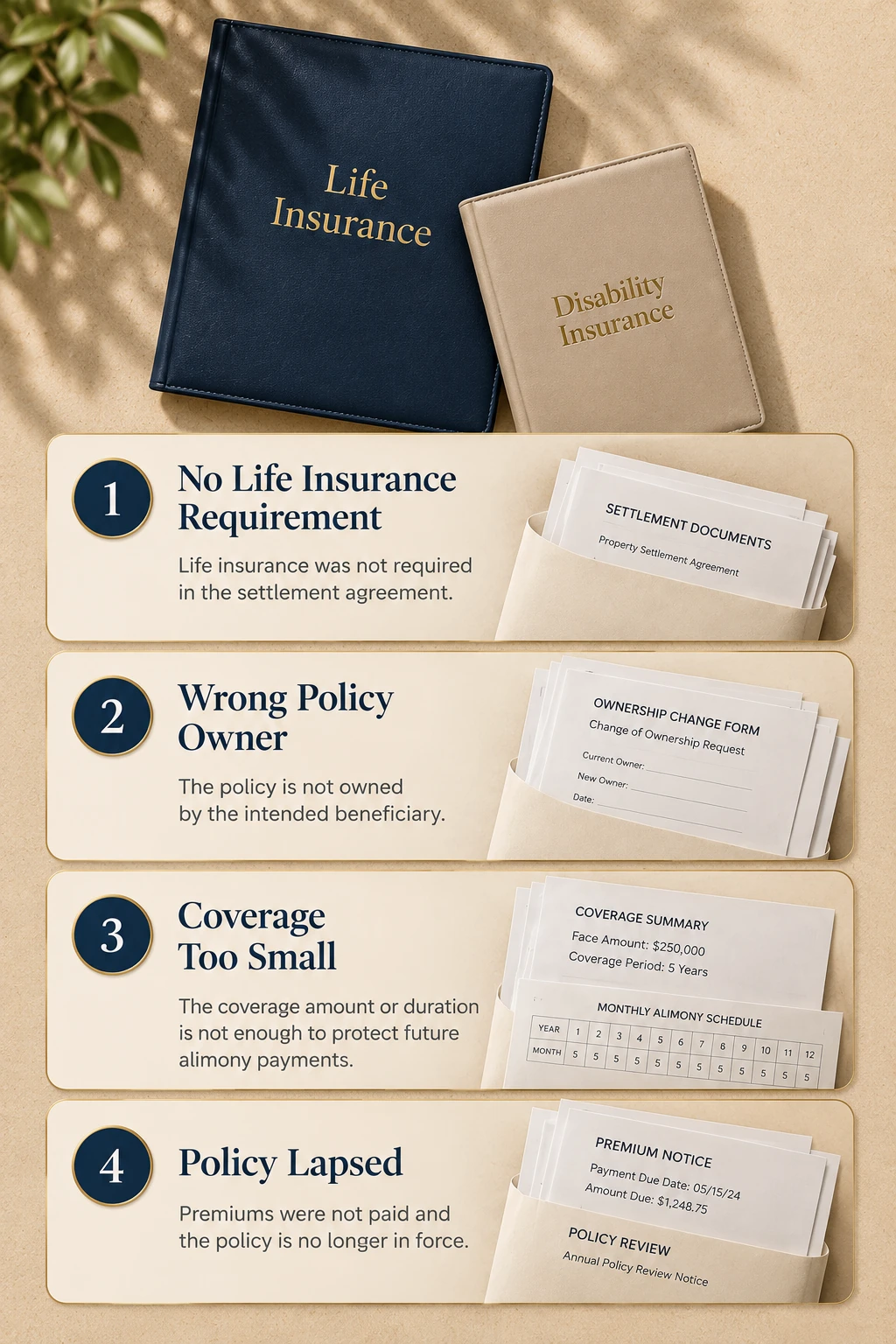
1. Not Having Any Insurance During Marriage
According to the World Street Journal, only 52% of U.S. adults today have life insurance. Are you one of them?
If you don't have any insurance, it can be very costly. Having insurance protects your ability to get insurance or so-called "insurability." Remember that you can only get insurance if you are healthy.
Further, if you have inexpensive term insurance during a marriage, you can convert it to a permanent policy later.
LIFE INSURANCE
Don't Wait Until You Need It.
Your health can affect your eligibility and the cost of life insurance. Explore your options while coverage is available and affordable.2. Not Having Enough Insurance
Even married couples who have life insurance may not have enough coverage.
Why?
Often, it's simply a lack of planning. And when divorce enters the picture, insurance planning becomes an important part of your overall divorce process.
What should you know?
First, if you have group life insurance through your employer, consider the following::
- Some employers provide $50,000 in basic group life insurance, while others offer coverage based on an employee's salary. The question is whether that amount is enough.
- Coverage may end when your ex-spouse leaves their job, unless it can be continued or converted.
- Group insurance terms may change following an employer merger or acquisition.
- Your ex-spouse may be able to change the beneficiary without notifying you, unless a court order or other legal restriction prevents it.
Second, if it is private insurance and you got it a while ago - when was the last time you reviewed it?
Your family has grown, you've bought a house, and you're earning more money—but you still have the same insurance coverage.
You got my point.
Use a life insurance calculator to estimate how much coverage you may need.
Check if you have enough protection!
3. Not Adjusting Insurance Needs at Separation
So, what's the difference between life insurance during marriage and life insurance that protects alimony after divorce?
When you're going through a divorce, life insurance becomes especially important if you'll be relying on alimony or child support.
Family law attorney Jennifer Millner points out that determining the right amount of insurance coverage is one of several issues to consider during divorce.
Remember, insurance requirements can vary by state, and coverage may be required for a specified period.
Of course, parents can choose to maintain life insurance coverage for longer. But that doesn't necessarily depend on good communication between ex-spouses. What if the divorce is bitter or, God forbid, a bloodbath?
KEY TAKEAWAY: During divorce, review your existing life and disability insurance policies. Do you need to adjust your coverage? Understand your state's rules for securing alimony payments.
Lesson 2: What to Know Before Getting Alimony Insurance

Next, getting life insurance to protect alimony payments can take time and planning.

Physical and medical records
Your ex-spouse may need to undergo a medical exam. Depending on the insurer and the policy, this could include blood and urine tests, vital signs, and sometimes an ECG. The requirements depend on several factors:
- Age
- Health condition
- Medical history
- Amount of insurance
The insurance company may also request medical records from your ex-spouse's physician, with your ex-spouse's authorization.

Cost of life insurance
Next, how much will life insurance cost?
The cost is especially important if you're buying a new policy at your current age. After all, you may need that coverage for many years.
But what is the price of peace of mind?
Age and health also matter. As The National Law Review points out, health issues can increase life insurance premiums, potentially creating a financial burden for one spouse.
For sure, it might not be an "equitable" solution.

Agreement between spouses
Both spouses may agree to purchase a life insurance policy to protect alimony payments or modify an existing one. But what if your spouse refuses to cooperate?
If you agree to maintain life insurance, include the premiums in your annual budget. The cost may also be considered when the court determines alimony.

Pre-existing conditions
Of course, your ex-spouse's health can affect their ability to get life insurance and how much it costs. But what if they have a serious medical condition?
First, don't wait until your divorce is final to explore life insurance options. What if your ex-spouse has trouble getting coverage later?
Second, what if your ex-spouse can't get life insurance? There may be other ways to protect your financial support::
- In certain circumstances, a court may require a paying spouse to establish a trust to help secure alimony payments.
- Your divorce agreement may provide for certain payments from your ex-spouse's estate after death. But what if there isn't enough money left to pay them?
- An immediate annuity may provide regular, guaranteed payments. The catch? Someone needs enough money upfront to purchase it.
KEY TAKEAWAY: Before your divorce is final, check your life insurance options, understand the costs, and make sure your alimony payments are protected.
But wait! There is more...
Lesson 3: How to Structure Insurance in Divorce

Even if your spouse is insured, you should know how to structure a policy to avoid major mistakes.
Remember Sarah?
Why did she lose alimony insurance?
Sarah was receiving monthly alimony under her divorce decree. The court had ordered Mike to maintain a life insurance policy naming Sarah as the beneficiary for as long as he was required to pay alimony.
About a year after the divorce, Mike stopped paying the life insurance premiums, and the policy lapsed. Sarah had no idea until he died.
Without the life insurance payout, Sarah lost the financial protection she was counting on!
Yes, Mike had violated the court order. But what could Sarah do now? He was gone, the insurance was gone, and there wasn't enough money in his estate to make up for what she'd lost.
So, how do you avoid ending up in Sarah's shoes?
One option is to own the life insurance policy on your ex-spouse yourself. That way, you have more control over the policy and can make sure the premiums are paid. Because the last thing you want is to discover that your financial protection disappeared without you knowing.
Another option is to name Sarah as an irrevocable beneficiary. Mike couldn't simply remove her without her consent. But what if he stopped paying the premiums? Sarah could still lose the protection she was counting on.
The safest approach is to have control over the life insurance policy. Former spouses can own policies on each other, or you, as the alimony recipient, can own the policy on your ex. That way, you can help ensure the premiums are paid and the coverage stays in place.
But what if your divorce is a bitter one?
You might think naming your children as beneficiaries is the answer. Not so fast! Especially if they're minors. That's another decision worth discussing with your attorney.
For more information and a detailed insurance review, contact us today!
KEY TAKEAWAY: If you receive alimony, owning the life insurance policy gives you more control. Being an irrevocable beneficiary offers another layer of protection, but make sure the premiums are paid!
Frequently Asked Questions: Alimony Insurance
I am sure you still have some questions. Let’s address some of them.
Yes, a permanent life insurance policy with cash value may be a marital asset, depending on when the policy was acquired and how it was funded.
You may be able to:
Surrender the policy and divide its cash value as part of your settlement.
Keep the policy and offset the marital portion of its value with another asset.
In Florida, the marital portion is subject to equitable distribution.
Generally, no—not in Florida. Term life insurance usually has no cash value to divide during divorce.
But don't overlook the policy! If your spouse has become uninsurable, keeping existing coverage could be especially important.
Not exactly. Life insurance can protect your alimony payments, but the insurance itself isn't alimony.
What about the premiums?
Under certain divorce agreements signed before 2019, premiums paid on a policy owned by the receiving spouse could qualify as alimony for tax purposes.
For divorce agreements signed after 2018, those premiums generally aren't tax-deductible as alimony.
It depends!
Under the Tax Cuts and Jobs Act of 2017 (TCJA), the rules changed for divorce agreements signed after December 31, 2018.
For these newer agreements, life insurance premiums paid to secure alimony generally aren't deductible as alimony. And if you're receiving support, those payments aren't taxable alimony income.
What about divorces before 2019? If your ex-spouse pays premiums on a policy covering their life that you own, those payments may qualify as deductible alimony. In that case, you would generally report them as taxable income.
And here's the good news: Life insurance death benefits are generally tax-free, regardless of when you divorced. However, interest and certain other exceptions may be taxable.
Generally, yes. But be careful!
During divorce, a court order may prevent you from changing your life insurance beneficiary. And if the beneficiary is irrevocable, you may need their consent.
What happens after divorce? In Florida, divorce generally revokes an existing beneficiary designation naming your former spouse, although there are important exceptions.
My advice? Talk to your attorney before making any changes. The last thing you want is an insurance surprise when your family needs the money most.
Generally, no. Once you're divorced, you usually lose your inheritance rights as a spouse.
But here's the catch! Your ex-spouse's will or divorce judgment may say otherwise. So pay close attention to the wording. It could make all the difference.
In Summary: Alimony Insurance Action Steps
I hope alimony insurance makes a little more sense now. More importantly, I hope you understand why having life insurance isn't enough. How the policy is structured matters just as much.
Before you finalize your divorce, here are five steps worth taking.
IN SUMMARY
Alimony Insurance
Action Steps
Identify Existing Insurance Policies
Review all life and disability insurance policies you and your spouse already have in place.

Verify Adequate Coverage
Make sure the insurance coverage is enough to protect future alimony and child support payments.

Include Insurance in Your Divorce Settlement
Make sure your agreement spells out the coverage amount, how long the policy must stay in place, and who pays the premiums.

Apply Before the Divorce Is Final
Complete the insurance application and underwriting process before your divorce is finalized, while coverage is still available.

Protect Your Beneficiary Rights
Shorter, cleaner, and consistent with the body text. My choice, Professor-approved!
Keep in mind that even if a court orders your ex-spouse to maintain life insurance, a policy that lapses may leave you without the protection you expected.
The right protection today can bring peace of mind tomorrow.
At Divorced Gals, we want you to understand your alimony insurance options, approach divorce with financial clarity, make informed decisions, and feel more confident about the life ahead.
Your Future Deserves a Plan.
Barry Giske
About the Author, Barry Giske
For Barry, it all started by accident...
Before the divorce advisory business, Barry worked hands-on in five critical areas: TITLE, MORTGAGE, REAL ESTATE, WEALTH MANAGEMENT, and INSURANCE. One day, his wealth management client--a family law attorney--asked Barry to talk to one of his divorce clients. She worries about future income, mortgage refinancing, re-titling her real estate properties, and insurance planning. Those are the areas where most divorcees face costly pitfalls. And this was where all of Barry's experience came into play.