


Are you feeling lost in the financial maze of divorce? A Certified Divorce Financial Analyst (CDFA®) can help you understand your options, avoid costly financial mistakes, and make informed decisions about your post-divorce future.
Meet Lora. She was in her forties, married with children, and facing a divorce.
The couple was always good with money: they bought a home, built a family business, and saved for retirement and a rainy day. That's why Lora was very optimistic about her future.
But!
Divorce brought an unexpected reality. First, Lora quickly discovered just how complicated the financial side of divorce could be. And second, her husband used aggressive tactics to secure a larger share of the marital assets.
What did she do?
Frustrated, she contacted me, a CDFA®, for help and guidance. She knew it could be instrumental in making informed financial decisions for a more secure post-divorce future. And that's what we will discuss in this post.
But first, what is a Certified Divorce Financial Analyst?
Client name and certain identifying details have been changed to protect confidentiality.
What is a Certified Divorce Financial Analyst®?

Financial Expert in the Divorce Process
To start, if you decide to split, I bet you have tons of looming questions:
A CDFA® is a financial professional trained to analyze the financial complexities of divorce. Think of them as your go-to financial expert in divorce, helping you understand your options, evaluate settlement proposals, and make informed financial decisions.
The goal of a CDFA® is to help you understand your finances, navigate the financial complexities of divorce, and evaluate the short- and long-term impact of different settlement options. Their expertise covers:
- Marital vs. Nonmarital Property
- Dividing a Marital Home and Other Real Estate
- The Real Cost of Divorce
- Valuation and Division of Assets
- Retirement Plans and Pensions
- Executive Compensation Division
- Tax Implications of Divorce
- Expert Witness Testimony
- Creative Divorce Financial Planning for Primary Breadwinner
- Short and Long-term Financial Impacts of Different Settlement Proposals
Click here for more information about CDFA services.
CDFA® vs. CPA and Financial Planner
A Certified Divorce Financial Analyst® may have a background in financial planning, accounting, or law. They undergo intensive training to become skilled at advising on the financial issues of divorce.
But how is a CDFA® different from a CPA or financial planner?
Think of a CDFA® as bringing together two worlds: accounting and financial planning, with one important difference — the focus is on the financial realities of divorce. Here's how these professionals compare:
CDFA® and Other Experts Professional Role
Focuses on current finances, taxes, and financial reporting. May also provide future projections. In divorce, they perform:
 business valuation
forensic accounting
calculate the tax effect of dividing assets
Helps people achieve financial goals regardless of a divorce or happy marriage. They focus on financial results in the future based on certain assumptions made today to see if the client is on track to meet their goals.
It blends two approaches: a CPA and a financial planner. CDFA helps the client and their attorney to understand how today's financial decisions in a divorce will impact the client's financial future based on specific assumptions.
CDFA® as a Reality Agent
Divorce can create tremendous financial stress. And much of that stress comes from fear of the unknown.
The last thing you need during divorce is to make financial decisions in the dark. That's where a Certified Divorce Financial Analyst® comes in — your REALITY AGENT. Someone who helps you see the numbers for what they are, understand what's at stake, and take back a sense of control.
Interested?
Who Should Use a CDFA®?

While anyone going through a divorce may benefit from working with a CDFA®, two practical questions are worth asking:
- Can you afford the services of a CDFA®?
- Are your finances complex enough to justify the cost?
CDFA Client Profile
CDFA® clients are often those with complex finances, substantial retirement savings, business interests, or multiple properties. They may find CDFA® services particularly valuable during divorce.
Additionally, CDFA clients household income and employment situations can look quite different:
- one primary wage earner
- two equally contributing wage earners
- retired couples
- one spouse retired, the other still working
And don't forget, people enter marriage with very different family and financial circumstances:
- first marriage or previous marriage
- children, step-children, or no children
- significant assets or no assets
- inheritance or potential inheritance
Lastly, high-net-worth individuals often have a team of professionals in their corner during divorce — including attorneys, CPAs, forensic professionals, and a CDFA® who brings specialized expertise in divorce finances.
How Much Does a CDFA Cost?
First, a CDFA® may charge an hourly rate, a flat fee, or a combination of both, depending on the scope of engagement.
You or your attorney can engage a Certified Divorce Financial Analyst® to prepare a comprehensive divorce financial analysis or work on a specific assignment. Check our divorce services A La Carte.
Second, CDFA® hourly fees vary by location, experience, and the complexity of your case. Expect to pay roughly $200 to $400 per hour, although some specialists charge more.
Alternatively, a CDFA® may offer a flat fee for a specific assignment or a comprehensive divorce financial planning engagement.
Who charges more?
Overall, the CDFAs with more experience and narrow expertise have higher fees, especially if they do forensic work. Also, litigation support and deposition assistance might trigger higher costs.
But who governs the activity of CDFAs?
IDFA: Institute for Divorce Financial Analysts

First, remember that divorce proceedings are different state by state. Therefore, each CDFA should be familiar with their specific state's rules and divorce statutes.
Additionally, some professionals might practice in more than one state or nationwide, depending on the type of engagement.
Second, the activity of Certified Divorce Financial Analysts is under the governance of The Institute for Divorce Financial Analysts (IDFA®). It is a premier national organization dedicated to the certification, education, and promotion of CDFAs in the divorce arena.

Certification
IDFA sets rigorous professional standards and certification requirements for CDFA® candidates:
- Experience
- Education
- Examination
- Ethics
These high standards give the public confidence that CDFAs are expected to follow a professional Code of Ethics and uphold standards of Professional Responsibility. You can rest assured that IDFA members follow the established practice norms and a specific process.
Divorce Financial Planning Process
Although the scope of a divorce financial engagement may vary, a CDFA® generally follows a five-step financial planning process:
Step 1.
Establish and define the relationship with a client:
- Agree on the scope of services
- Agree on fees and payment terms
- Disclose any limitations or conflicts of interest
Step 2.
Gather client data:
- Obtain quantitative and qualitative information and documents
Step 3.
Complete the financial analysis:
- Use unbiased judgment and sound economic principles when developing a financial opinion
Step 4.
Present and deliver the assignment
Step 5.
Complete the engagement
- Send a letter to the client confirming the completion of the engagement.
How to Find a Certified Divorce Financial Analyst
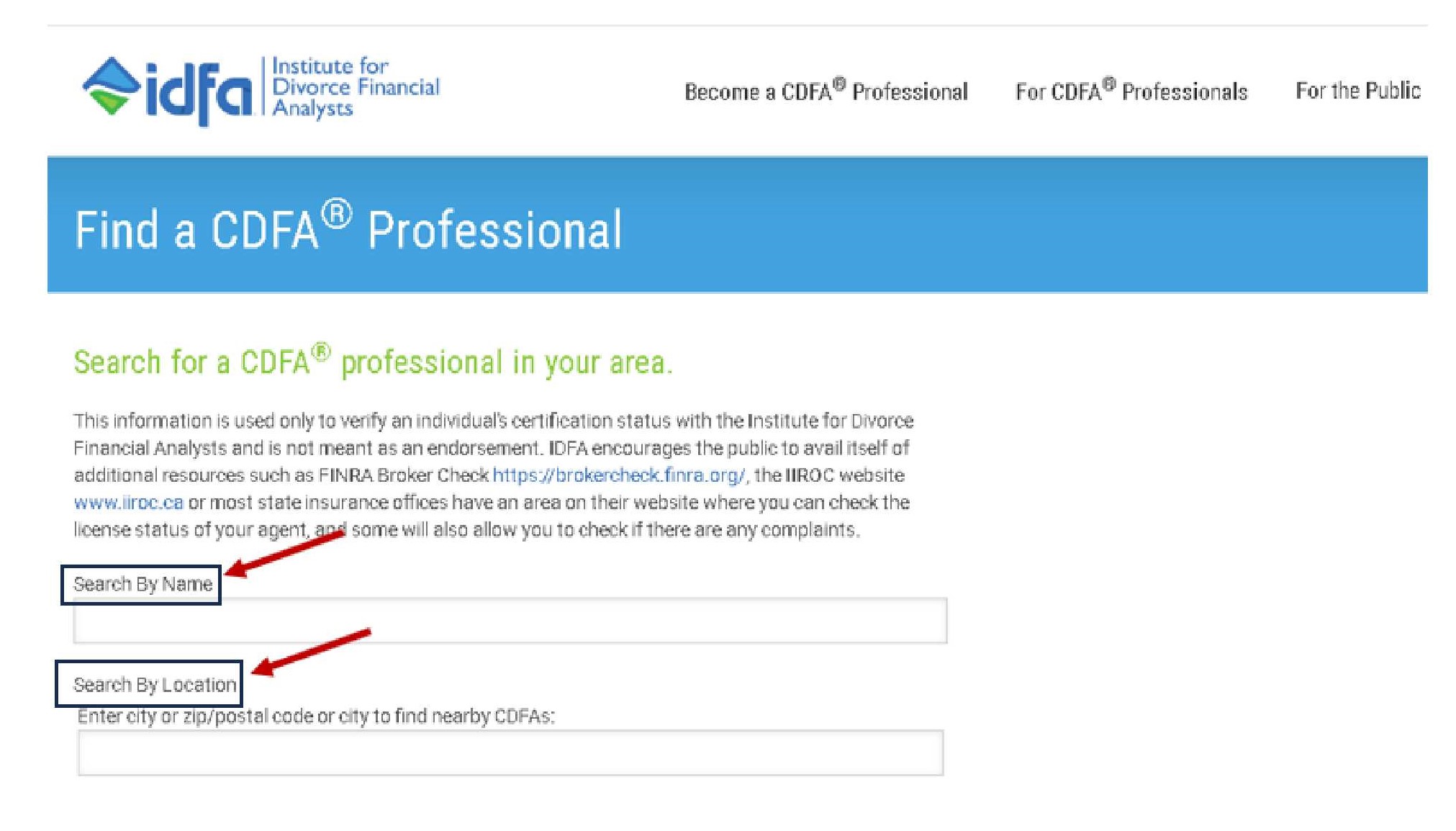
IDFA maintains an online directory where you can search for CDFA® professionals and view their profiles and contact information. Here's how to find one:
- Go directly to IDFA's Find a CDFA® Professional directory.
- Search by name, location, or specialty.
- Select your preferred search criteria and review the results.
- Open a professional's profile to learn more and find their contact information.
PRO TIP: Look for a CDFA® with a dedicated divorce practice and a professional website — someone who specializes in divorce financial analysis rather than offering it as an occasional service alongside wealth management or brokerage.
But wait!
Before you take the next step in your divorce, check out my CDFA® profile and go through our Pre-Divorce Checklist: 7 Sure Steps for Better Divorce.
Frequently Asked Questions about CDFAs
Yes, you may benefit from both. Your divorce attorney handles the legal side of divorce, while a CDFA® focuses on the financial picture. A CDFA® can analyze assets, retirement accounts, taxes, and the long-term consequences of settlement options. Together, they can help you understand not just what you're entitled to, but what different financial decisions could mean for your future.
Ideally, before you make major financial decisions or agree to a settlement. A CDFA® can help you organize financial information, identify questions worth investigating, and compare settlement scenarios. Even if your divorce is already underway, bringing in a CDFA® before finalizing financial terms may help you avoid costly surprises.
Absolutely. But keeping the house isn't just about whether you can afford the mortgage today. A CDFA® can examine home equity, refinancing, property taxes, insurance, maintenance, and future cash flow. The goal is to help you evaluate whether keeping the house makes financial sense alongside the rest of your settlement.
Yes. A CDFA® can analyze retirement account values, tax consequences, and different division scenarios. However, certain retirement plans require a Qualified Domestic Relations Order (QDRO), which involves legal drafting and plan approval. A CDFA® provides the financial analysis, while the appropriate legal professionals handle the legal documents.
It depends on your financial circumstances. If you have retirement savings, real estate, business interests, or complicated settlement options, a CDFA® may help you understand financial consequences that aren't immediately obvious. The value isn't simply what you might save today — it's having better information before making decisions that could affect your finances for years.
Final Thoughts...

Moving Forward with Financial Confidence After Divorce
Remember Lora?
When we first met, Lora had hit rock bottom. She was worried sick about the financial challenges of her divorce:
Analyzing her assets and liabilities Tax implications of dividing marital property Dividing 401(k)s and pensions Paying bills Survivor benefits Finding ways to generate additional income
Little by little, I helped Lora move from financial chaos to clarity and make powerful, informed choices. Together with her attorney, we worked toward a more equitable settlement, saving her time, money, and a lot of frustration.
Result?
Lora regained her strength and confidence. Today, she's happy and excited about her financial future. And that's the power of working with a Certified Divorce Financial Analyst®.
Remember, when emotions run high and uncertainty looms, a CDFA® can help you navigate the financial maze of divorce.
Could you afford not to have one?
For the life you're building,
Nella Zelensky
About the Author
Facing her own divorce, Nella discovered firsthand how overwhelming financial decisions can become—even with a background in finance. That experience inspired her to focus on divorce financial analysis. Building on an established career in finance, she earned the Certified Divorce Financial Analyst® (CDFA®) designation, followed by the Master Analyst in Financial Forensics® (MAFF®) credential.
Today, as Co-Founder of The Divorced Gals, Nella helps women understand the financial consequences of divorce, ask better questions, and make decisions with greater clarity and confidence.