


Let me guess: you and your spouse divide 401(k) in a divorce, and you think that divorce and 401(k) are complicated...
You might be wondering: "How is a 401(k) split in a divorce? Do I get half of my husband's 401(k)? Who pays taxes on a 401(k) that's divided in a divorce?"
There are plenty of questions and even more "what ifs."
And it's easy to feel overwhelmed. After all, a 401(k) may be one of your largest financial assets, second only to your marital home. The last thing you want is to make an expensive mistake.
That's where I come in.
I'll break down some of the confusing financial issues surrounding divorce and 401(k) plans into everyday language. We'll also look at three common tax mistakes and how to avoid them, using real-life examples.
Let's dive in, starting with the basics of 401(k) plans and divorce.
Divorce and 401(k) Plans Basics
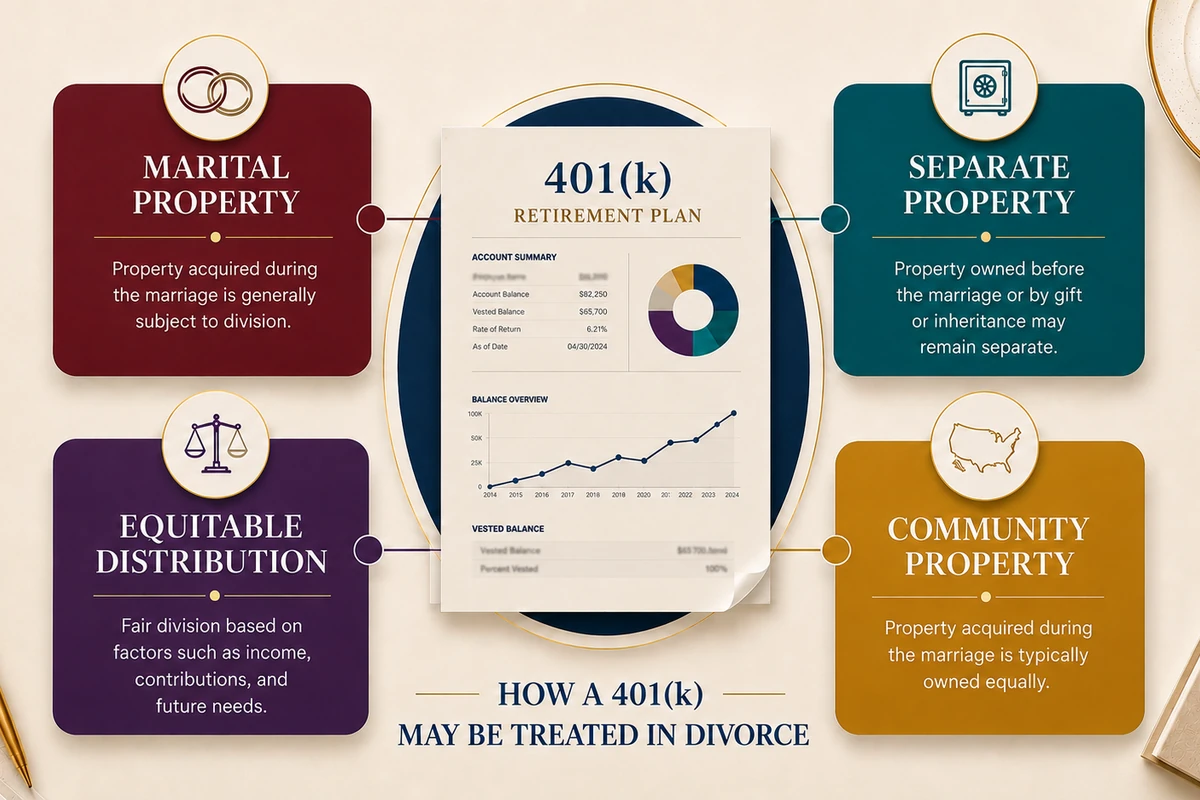
It is imperative to know that divorce and splitting 401(k) assets might differ from state to state.
Community Property vs. Equitable Distribution
There are two types of property division statutes: community property and equitable distribution.
In community property states, assets acquired during marriage are generally considered community property and are typically divided equally, although exceptions apply.
So, if you are asking, "Do I get half of my husband's 401(k) in a divorce?" The answer is "yes" if you are in a community property state.
Exceptions are:
- Separate property before the marriage
- Gifts or inheritance
Equitable distribution states use the principle of "fair and equitable" distribution, which doesn't necessarily mean 50/50.
What else should you consider?
401(k) Plans: Marital vs. Non-Marital Portion
What is the difference between marital and separate property in divorce and 401(k) plan?
Generally, if you or your spouse didn't contribute to a 401(k) plan before the marriage, the total balance is a marital asset and is to be divided.
However, if you or your spouse contributed to a plan before tying a knot and can prove it(!), that portion is so-called a "separate" property and not subject to a division. In this case, you might need a valuation of the account, which can be a simple calculation.
But!
A pre-divorce portion of the 401(k) plan can significantly impact earnings. A specially trained professional like a CDFA® (Certified Divorce Financial Analyst®) can help you with Separate and Marital Property Tracing and Valuation.
Vested vs. Non-Vested Balances of 401(k) Retirement Assets
Vested money in your 401(k) belongs to you, whether you stay with your employer, retire, or leave. Nonvested employer contributions, however, may be forfeited if you leave before meeting the plan's vesting requirements.
Some states divide only vested retirement benefits in divorce, while others also recognize nonvested benefits as marital property.
Florida is one of those states. Under Florida Statutes §61.076, both vested and nonvested retirement benefits accrued during marriage are marital assets.
For example, suppose your spouse's employer contributes $20,000 during your marriage, but full vesting requires five years of service. Even if your spouse hasn't completed those five years, the unvested portion may still be marital property. Its value and division depend on the plan's rules and your circumstances.
KEY TAKEAWAY: If part of your 401(k) predates your marriage, you'll generally need records to establish and trace its nonmarital value.
Taxes on a Division of 401k in a Divorce

And now, a big elephant in the room: paying taxes on the income from splitting a 401(k) in a divorce.
Generally, you will pay ordinary income tax on a distribution from a qualified plan. But here, there are a few ifs
IRC Section 72(t) Divorce and 401(k) Plans Exception
Do you know the earliest age to access money in a defined contribution plan without penalty?
That's right. It's 59 ½.
However, there are some exceptions:
- Death and disability
- Medical expenses
- Qualified higher education
- Annuity payments for the life expectancy of a person
- Divorce
Yes, if you're under age 59½, you may receive your share of your spouse's 401(k) without the usual 10% early withdrawal penalty under IRC Section 72(t).
But there's an important condition: the payment must come directly from the qualified retirement plan under a Qualified Domestic Relations Order (QDRO).
And remember, avoiding the 10% penalty doesn't necessarily mean avoiding ordinary income taxes. We'll get to that next.
Please keep reading. There is much to a story.
Dividing a 401(k) Without Tax Penalties
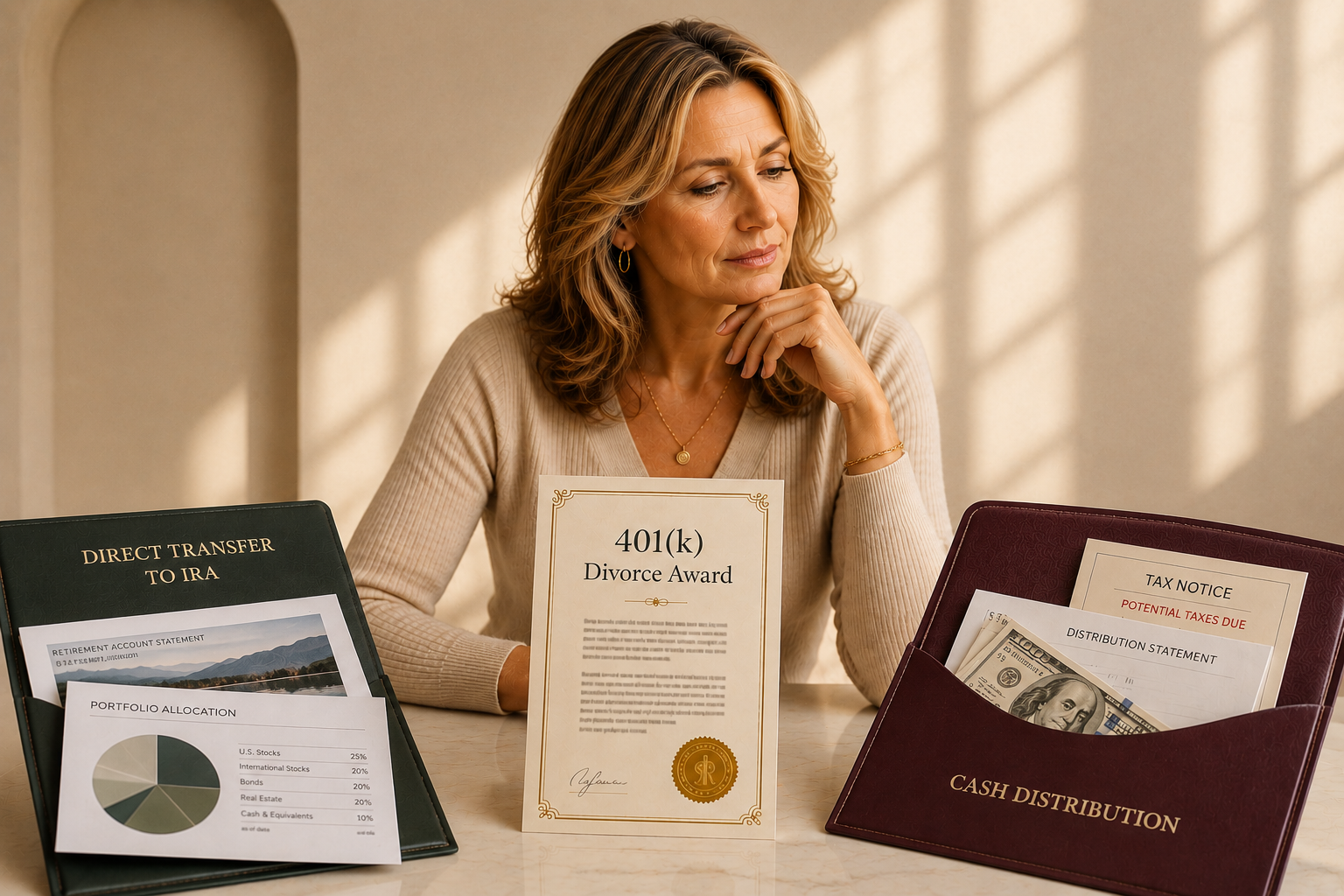
Direct Transfer vs. Rollover
Next, you probably heard phrases like "direct transfer" and "rollover."
The difference?
If you transfer money from a qualified plan to an IRA, a check is sent directly from the 401(k) plan to the IRA. You never touch the money, and it is a direct transfer.
In a rollover, on the other hand, the plan sends money to you first, and then you put funds into the IRA.
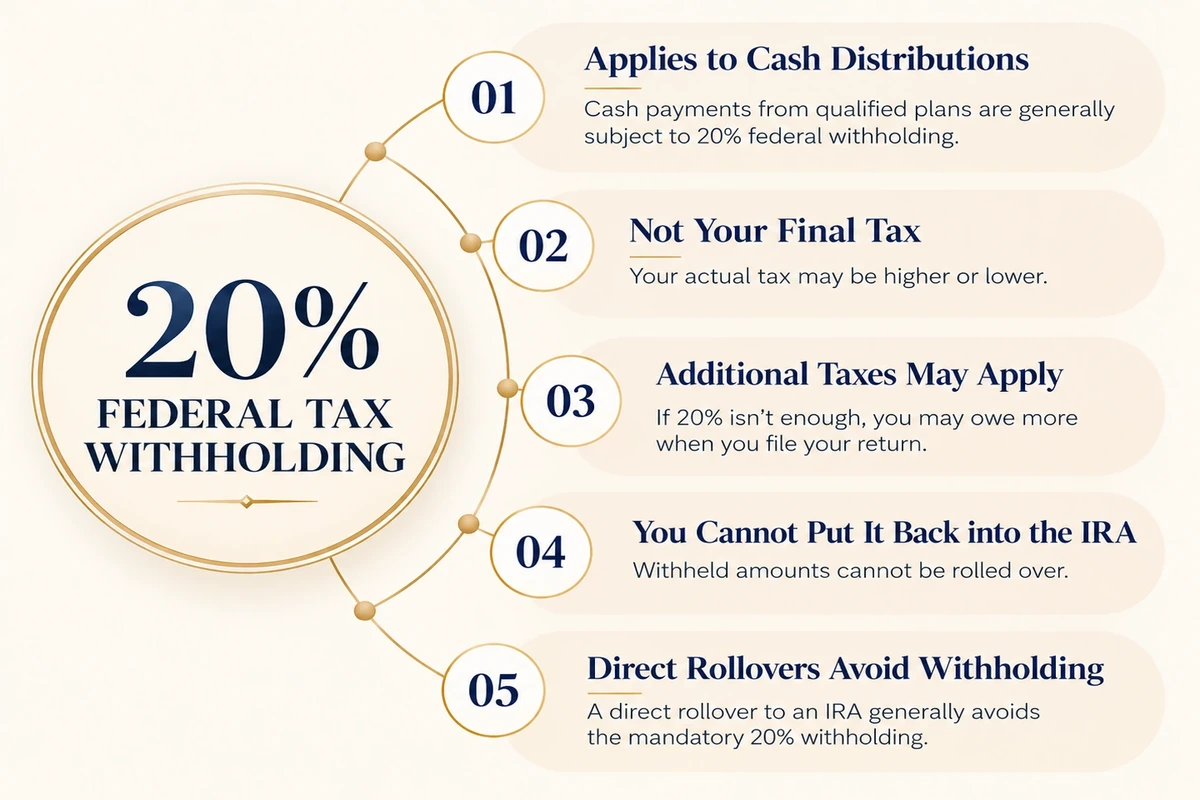
As a result, an eligible rollover distribution paid directly to you is generally subject to mandatory 20% federal income tax withholding. However, that doesn't necessarily mean the distribution will be taxable. We'll illustrate why in one of our mini-cases.
I should note that often, a direct transfer refers also to a trustee-to-trustee transfer or a direct rollover.
You might ask: "Is there any specific protocol to transfer 401(k) money without tax consequences?"
Yes!
A Qualified Domestic Relations Order (QDRO) is a court order used to divide certain retirement plan benefits in a divorce. For a 401(k) covered by ERISA, a QDRO generally allows a spouse or former spouse to receive an assigned share directly from the retirement plan.
QDROs can be complicated, so we'll leave the technical details for another article.
Divorced Gals now offers flat-fee pension valuation and QDRO facilitation services. We would be happy to answer any questions regarding plan terms, election options, or survivor benefits. Learn more about our services.
KEY TAKEAWAY: If you're under 59½, you can generally receive money from your spouse's 401(k) without the 10% early withdrawal penalty if the payment is made under a QDRO (IRC Section 72(t)). But you may still owe income taxes. Knowing how to transfer or roll over the money can help you avoid costly tax mistakes.
Let's see how divorce and splitting 401(k) plan works, where tax mistakes can happen, and how to avoid them.
Mary is 54 and recently divorced. Under her divorce settlement, she receives $300,000 from her husband's $600,000 401(k) plan.
What are Mary's options?
Case Study #1: 401(k) Direct Transfer and IRA Cash Out in a Divorce
IRA Withdrawal
(Tax + 10% penalty)
If Mary withdraws money from her IRA at age 54, she will generally pay:
1. Ordinary income tax on the taxable withdrawal.
2. An additional 10% early withdrawal penalty, unless another IRS exception applies.
By the way, remember that an IRA is not a qualified plan. Of course, some qualified expenses allow you to get money from the IRA penalty-free, but it is a separate topic.
KEY TAKEAWAY: Cashing out a traditional IRA before age 59½ after rolling over 401(k) funds. The withdrawal generally triggers ordinary income tax and a 10% early withdrawal penalty, unless an exception applies.
Case Study #2: Divorce - Should You Cash Out 401(k)?
What if Mary needs cash before rolling over her share of the 401(k) to an IRA?
Let's assume $25,000 to pay her attorney and $55,000 for house renovations.
Of course, you might ask, "How about Mary's savings or other cash resources?"
You are correct. Using retirement money before retirement should be the last resort!
But let's continue with our example.
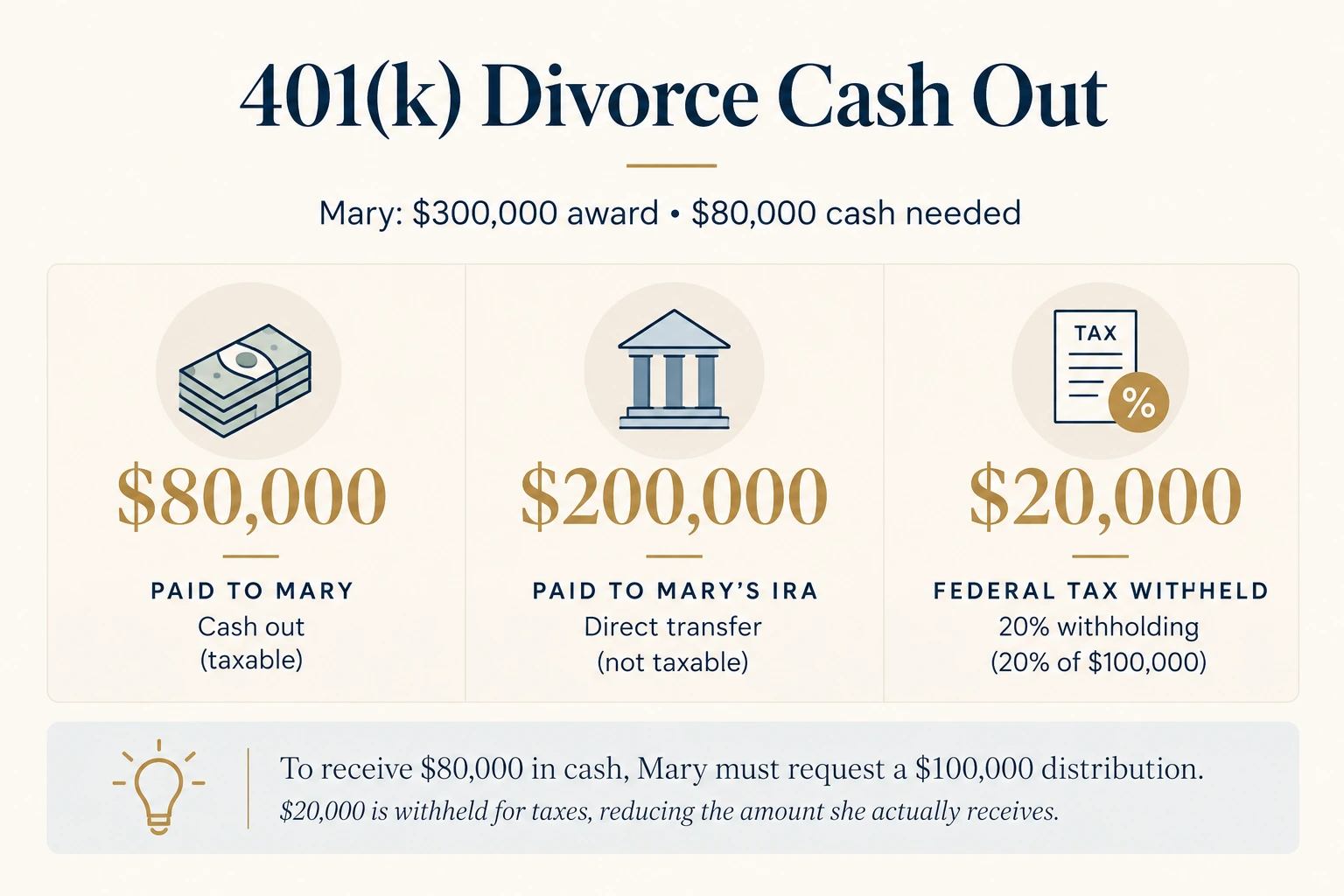
Mary needs $80,000 in cash. But what about the mandatory 20% federal income tax withholding?
To receive $80,000 after withholding, Mary requests a $100,000 distribution directly from the 401(k) under the QDRO.
Here's how her $300,000 award breaks down:
- $80,000 — Cash Mary receives after federal income tax withholding.
- $200,000 — Direct rollover to Mary's IRA, with no immediate income tax.
- $20,000 — Federal income tax withheld (20% of the $100,000 cash distribution).
The divorce and 401(k) example above has a more subtle potential problem.
We don't know how much federal income tax Mary will actually owe. Right?
The $20,000 withheld may be more or less than her final tax bill.
If the withholding isn't enough, Mary may owe additional taxes when she files her return. But if too much was withheld, she may receive a tax refund.
Remember, the 20% withholding is an advance payment toward her taxes, not necessarily the amount she ultimately owes.
What else should you know about 20% tax withholding?
Let's use an example of rollover.
KEY TAKEAWAY: Think twice before cashing out retirement funds. A direct rollover preserves tax deferral, while taking cash from a 401(k) can trigger income taxes and mandatory 20% withholding.
Case Study #3: Divorce and 401k Rollover
Another scenario.
Assume that after a divorce and 401(k) assets split, Mary receives her ex-husband Paul's $100,000 401(k).
She didn't want his mutual funds in her account, so she requested money sent to her.
Then, she rolled over money into different mutual funds of her choice. Of course, since the check was made directly to her, the rollover is subject to a 20% withholding tax.
So, Mary deposited in her IRA $80,000.
Next, the $20,000 withheld is considered a withdrawal and subject to tax.
Can Mary do something to avoid it?
Yes!
She could have added $20,000 of her own money, but unfortunately, she did not have extra cash. It's a pity since the IRS would have probably refunded that amount to her after filing her taxes.
Further, let's assume that Mary is in the 33% tax bracket between federal and state taxes. Here, she will pay an extra $6,600 in taxes.
Of course, when it was time to file her tax return, $20,000 in taxes was already paid.
Another issue Mary has:
- Effect of having an extra $20,000 growing tax-deferred
Now you see how it is critical to consult your financial professional or tax advisor before distributing 401(k) plan money.
Contact Divorced Gals and talk to Nella Zelensky, a CDFA® (Certified Divorce Financial Analyst®).
KEY TAKEAWAY: When receiving 401(k) assets through a QDRO, arrange a direct rollover to your IRA with the plan administrator. This generally avoids the mandatory 20% federal income tax withholding.

And now on to the FAQ…
FAQ: 401(k) Split During a Divorce
No. You will generally need to start taking required minimum distributions (RMDs) at age 73 or 75, depending on your birth year.
Yes, but using 401(k) funds to pay for a divorce may trigger income taxes and an early withdrawal penalty. Before withdrawing money, consult your attorney and tax advisor, especially if the funds are marital assets.
There are options if you want to keep as much of your 401(k) money as possible. Consider:
- How close you are to retirement
- Whether selling your home could free up other assets
- Whether you can adjust your lifestyle to rebuild retirement savings after divorce
Keep in mind that divorce settlement is all about negotiation. Therefore, you might offer your spouse another asset instead of your 401k money.
It is illegal to hide any assets during a divorce. As part of a Florida divorce, you generally must complete a sworn Financial Affidavit disclosing your income, expenses, assets, and liabilities. Knowingly providing false information can have serious legal consequences, including potential perjury charges. End of story.
If you cash out your 401(k) before divorce to make your retirement savings appear smaller, you may still have to account for the full amount in the division of marital assets. You could also face a claim that you wasted marital assets if you spent the money for purposes unrelated to the marriage.
Also, "hiding" money this way is easily discoverable since you will be preparing your sworn Financial Affidavit and supplying all supporting documents and statements.
Additionally, cashing out your 401k can be very expensive. Consider the following:
- ordinary income tax
- possible federal income tax withholding
- 10% early withdrawal penalty (if you are under 59 1/2)
- losing creditor protection
- losing potential tax deferred growth
Some 401(k) plans allow hardship withdrawals for certain expenses, including medical and funeral costs. However, a hardship withdrawal does not automatically exempt you from the 10% early withdrawal penalty. Income taxes may also apply.
It is not only about having a divorce settlement. It depends on when a QDRO (Qualified Domestic Relations Order) was filed. QDRO is a complex and mandatory document for dividing qualified retirement plans.
The correct question to ask is "What is the valuation date of the 401k plan?"
If your state considers the value of the plan as a marital asset till the day of the divorce, it makes sense to put your contribution on hold and not to grow your spouse's portion on your dime.
If, on the other hand, your 401k contribution and earnings are "yours" (separate property) and not marital property after the date of separation, there is no need to stop contributing.
Word of Wisdom: remember that when you stop your 401k contribution, you also don't receive your company matching contribution which is "free" money plus potential tax-advantaged growth.
Final Thoughts...

I hope I did justice to the main idea of divorce and 401k and that you are no longer confused.
Let's summarize.
First, there are three potential tax mistakes when dividing 401k plan in a divorce:
MISTAKE #1: Not considering the mandatory 20% federal tax withholding when an eligible 401(k) rollover distribution is paid directly to you instead of your IRA.
MISTAKE #2: Overlooking income taxes and the potential 10% early withdrawal penalty when cashing out money from an IRA after a 401(k) rollover.
MISTAKE #3: Potential unnecessary tax liability.
Now you know what to do. Go back to each divorce and 401k case study and see what is best for you.
Second, I hope that you take the next step and find out everything you can about your and your spouse's 401(k):
- Do I know where my 401(k) money is?
- What is my current vested balance?
- What distribution options does my 401(k) plan offer after divorce?
- Did I start my 401k before marriage, and if yes, do I have statements from back then?
- Have I ever taken a loan from my 401(k)?
- What are the rules about divorce distribution options and 401(k)?
- Where is all my enrollment paperwork?
Yes, it's a complex process to understand all you need to know about your divorce and 401(k) assets. Yes, some of the issues can be daunting. And, yes, there is still a lot for you to learn.
But you are not alone, and you're on your way, which is a critical part of your divorce process.
And when you get your most beneficial divorce settlement, it will all be worth it.
For Divorce and 401(k),
Know Your Options.
Start a Private Conversation!
Last word of wisdom: when dealing with divorce and 401(k) plan, be involved and know your options. After all, it's YOUR money!
For the life you're building,
Nella Zelensky
About the Author
Facing her own divorce, Nella discovered firsthand how overwhelming financial decisions can become—even with a background in finance. That experience inspired her to focus on divorce financial analysis. Building on an established career in finance, she earned the Certified Divorce Financial Analyst® (CDFA®) designation, followed by the Master Analyst in Financial Forensics® (MAFF®) credential.
Today, as Co-Founder of The Divorced Gals, Nella helps women understand the financial consequences of divorce, ask better questions, and make decisions with greater clarity and confidence.