


Imagine you have a big treasure chest with coins, jewelry, and all the other things you have. And now, when you file for divorce in Florida, you have to open it and go through all your treasures one by one. How? You need a treasure map – your Florida financial affidavit.
But how do you make a treasure map?
You write down all your valuables: a house, car, savings, investments, and other precious jewels. You also add the money you receive, like salary or commission.
Next, you write what jewels you take out to pay for food, clothes, toys, and vacation.
Finally, did you promise anyone something? It also goes to your treasure chest.
Now, you have your treasure map ready.
Curious?
This post is your guide to how to prepare your Florida financial affidavit. If you do it right, you can better protect your assets during divorce. And this is our goal.
But first, let's take a closer look at financial affidavit meaning.
What is the Florida Financial Affidavit?
First, the Florida financial affidavit form is a comprehensive document used in family law cases in the Sunshine State. It is one of the mandatory Florida divorce forms.
Second, it provides a detailed disclosure of each spouse's finances, including:
- income
- expenses
- assets
- liabilities
Think about them as four shiny coins in your treasure chest you either have or owe someone.

Third, the affidavit is a sworn statement that you sign under penalty of perjury.
Next, what is the purpose of the financial affidavit?
The court needs to know the parties' financial picture to determine child support, alimony, property division, and other financial issues fairly.
You can amend your affidavit if you recall or discover new information. You might also have your financial numbers changed after filing the initial affidavit. It is normal since, after a split, both parties better understand living expenses as a single person.
When Should You File Financial Affidavit for Divorce?
You file the signed financial affidavit with the Clerk of the Circuit Court in the county where the divorce petition was filed. Remember to keep a copy for your records.
You must also serve a copy of the affidavit on the other party or their attorney.
Generally, you must file and serve your financial affidavit:
- with your initial filing
- within 45 days after the divorce petition is served on the other party
Different deadlines or exceptions may apply depending on your circumstances or a court order.
You must serve the affidavit using an approved method, such as mail, e-mail, or hand delivery, following Florida's rules for service of court documents.
 If you file Florida divorce forms without an attorney, visit the Florida Courts E-Filing Portal's Training Videos page for step-by-step guidance on filing a new case.
The next question: "Are there different versions of the financial affidavit for divorce in Florida?"
Affidavit Short Form vs. Long Form
Depending on the size of your treasure chest, you will use a different treasure map.
Florida Courts use family law financial affidavit Form 12.902(b) or (c).
The short form—Form 12.902(b)—is for individuals whose gross annual income is less than $50,000.
The long form—Form 12.902(c)—provides a more detailed picture of your finances. It may require supporting documents such as bank and brokerage statements.
See below a comparison between Florida financial affidavit short and long forms.
Florida Financial Affidavit
long Form
- Form 12.902(c)
- Comprehensive form
- Individual gross annual income is $50,000 or more
- Detail inventory of all Income, expenses, assets, liabilities, real estate holdings, businesses, and personal properties
IMPORTANT FORM UPDATE
As of October 2026, Florida Courts lists the Short Form (12.902(b)) with a revision date of October 2021 and the Long Form (12.902(c)) with a revision date of June 2025.
Before completing either affidavit, check the official Florida Courts forms directory for the most current version.
In this post, we will review how to fill out Florida family law financial affidavit long form.
Financial Affidavit Information Gathering

Remember that our goal is to secure your assets in divorce. Right?
First, before you start working on your Florida financial affidavit, it is smart to collect and organize the necessary information. Below are examples of what you should have in your divorce file:
 Pay stubs
Tax returns (last 3 years)
W-2 forms, 1099 forms
Mortgage statements and loan documents”
Bank and investment statements (all pages)
401(k) account statements
Individual Retirement Account (IRA) statements
Next, organize your financial information and make sure you have contact details for the professionals and organizations you may need:
- attorney
- CPA
- financial professional
- insurance broker
- employer
- primary care physician
- health insurance company

Also, how well do you know all your accounts, insurance, real estate, and other assets?
 ACCOUNTS. Where are your accounts held? What are the financial institutions, account types, and account numbers? Do you have access to your statements?
INSURANCE POLICIES. Who owns each policy? Who is the beneficiary? What is the policy number and type? What is the death benefit? Does the policy have a cash value? How much are the premiums?
REAL ESTATE. Did you buy a house before marriage? If yes, what was the house value on the date of a marriage? What's the interest rate? How much is your mortgage balance? What is the current value of the property? What was the mortgage balance when you married?
Let's start working on your treasure map - your Florida financial affidavit.
Affidavit Section 1: Income
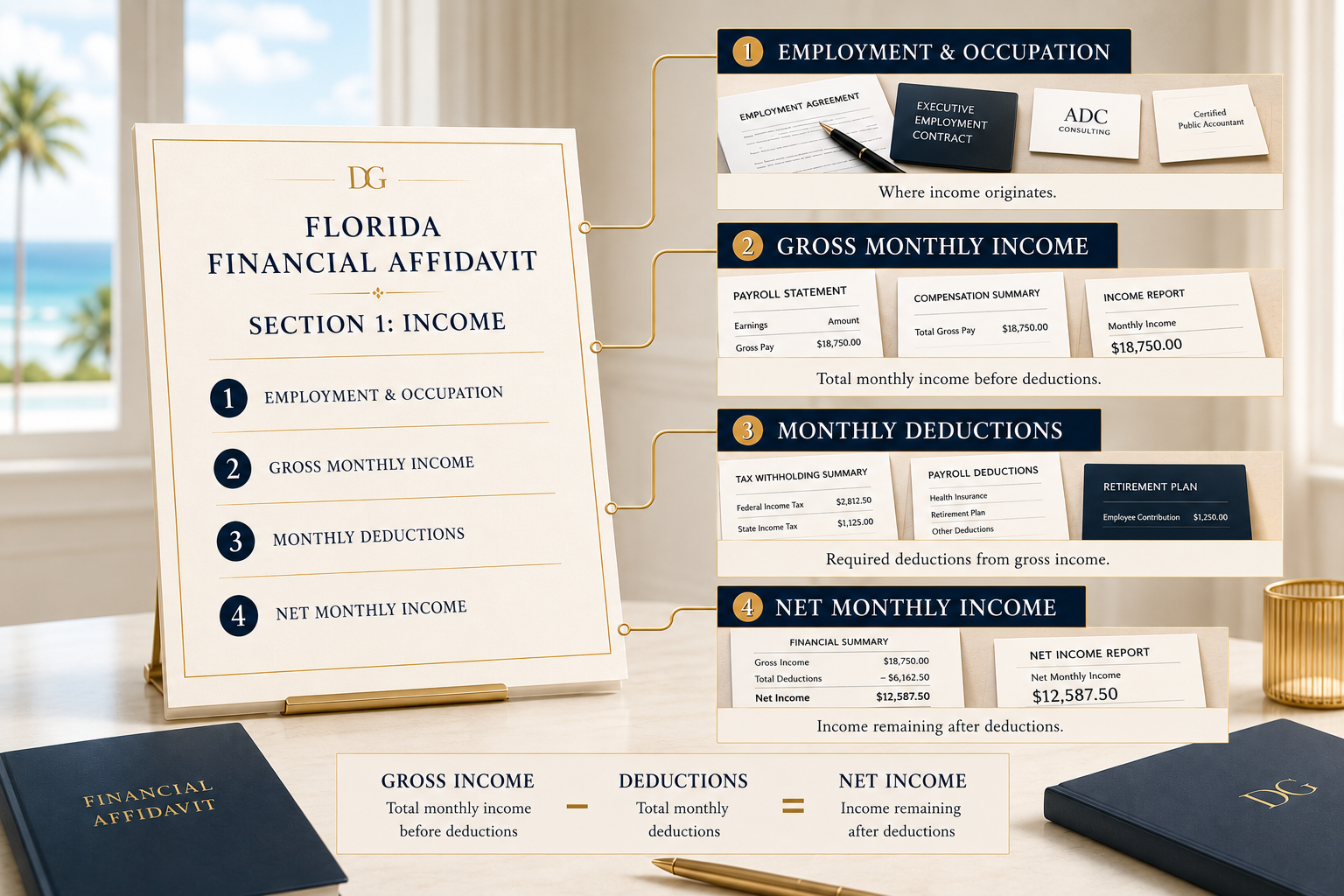
The first shiny coin in your treasure chest is your income. Respectfully, you will find the detailed income description in Section 1 of the Florida financial affidavit.
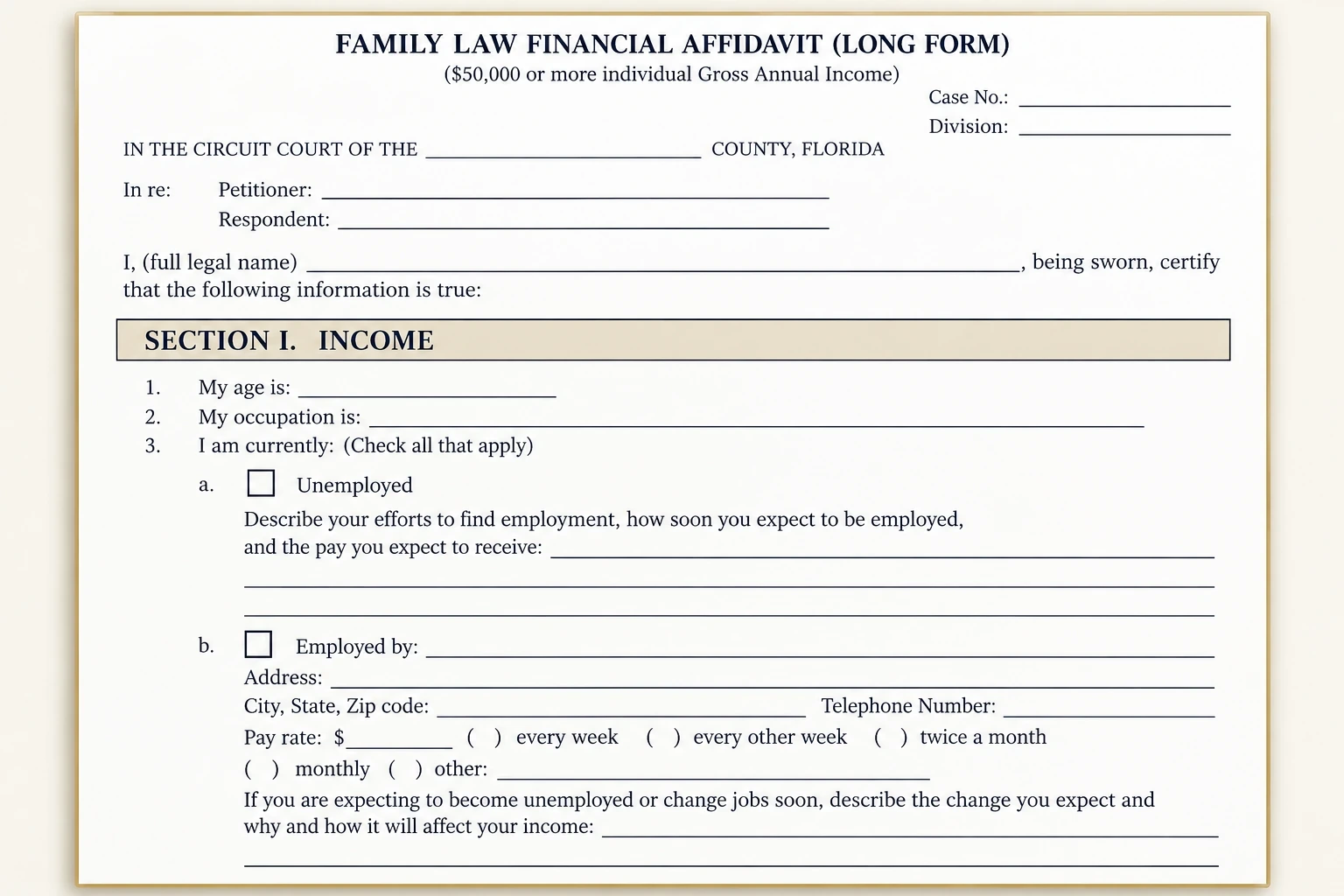
Illustrative excerpt of the Florida Family Law Financial Affidavit (Long Form), Section I: Income. Not an official court form.
INCOME SECTION has three subsections and asks about the following:
1. Age, Occupation, Employment, Retirement

This part is self-explanatory. If you write additional information, be brief and to the point.
2. present monthly gross income

3. Present monthly deductions

All amount must be MONTHLY and cover the following deductions:
The final number of the Income section is PRESENT NET INCOME (you subtract total deductions from total present gross income).
PRO TIP: Enter gross income as it is shown on a pay stub before any deductions. Typically, this would be a larger number than would be shown on a W-2.
Common Mistakes When Completing Affidavit Income Section
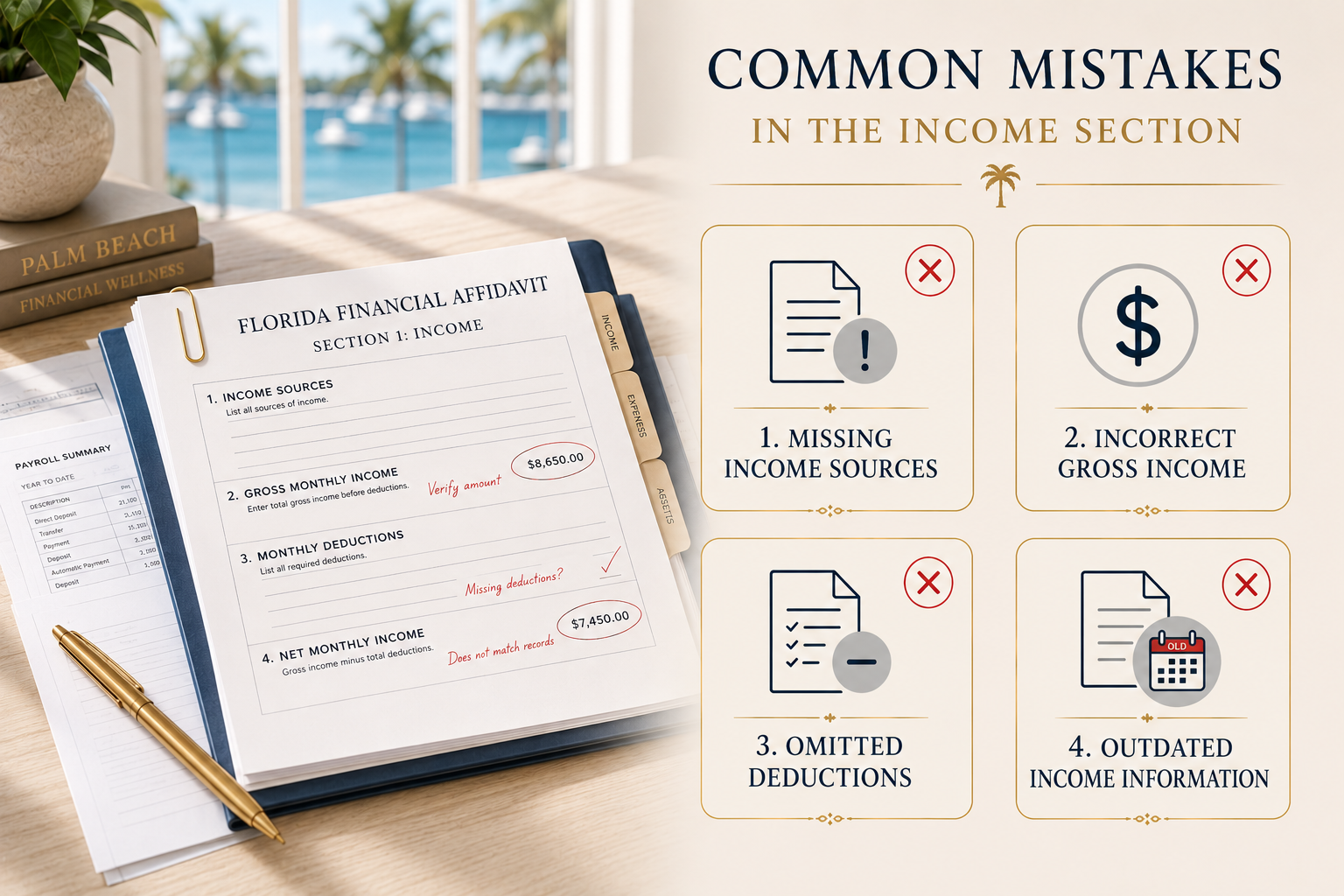
Want to avoid mistakes and possible delays?
Mistakes in your Florida financial affidavit can cost you! Remember that our goal is to secure your assets in divorce.
Recently, a couple--Paula and Mike--called me as a CDFA® (Certified Divorce Financial Analyst®) to review their affidavit. I found numerous common errors, made all adjustments, and prepared a revised version.
Let's go through some of those pitfalls.
1. Not Providing Accurate Information
Remember garbage in, garbage out?
That's why you should be very precise. Paula needed to be more organized and have all the records. Again, you must have your information ready and have copies of all your statements and documents.
2. Not Calculating Monthly Income Properly
Paula told me she was paid twice a month (24 times a year). However, her pay stubs showed that the checks were 14 days apart. It was clear that she actually got paid bi-weekly or 26 times per year.
3. Not Knowing the Number of Paychecks
In addition, Paula forgot that, in reality, she received 19 paychecks for a year. As a result, I reduced Paula's monthly income by $330. It would not be good if she showed that she made more money.
PRO TIP: If you adjust the number of your paychecks, you should recalculate your monthly income, deductions, and Net Monthly Income.
4. Double-Counting
Next, Paula included her health insurance payments as a deduction. She also had the same numbers later as an "expense" in Section 2. As a result, she deducted those dollars twice, which is double-counting and prohibited.
5. Not Including All Income
Next, Paula cashed her company stock for whopping $90,000 but didn't add proceeds to her income. After a review, I knew money couldn't mysteriously appear from a thin year.
So be sure to provide information about your income from all sources like employment, self-employment, rental properties, investments, and any other sources of money you receive.
And now, let's look at a coin in your treasure chest when you pay for things.
Affidavit Section 2: Expenses
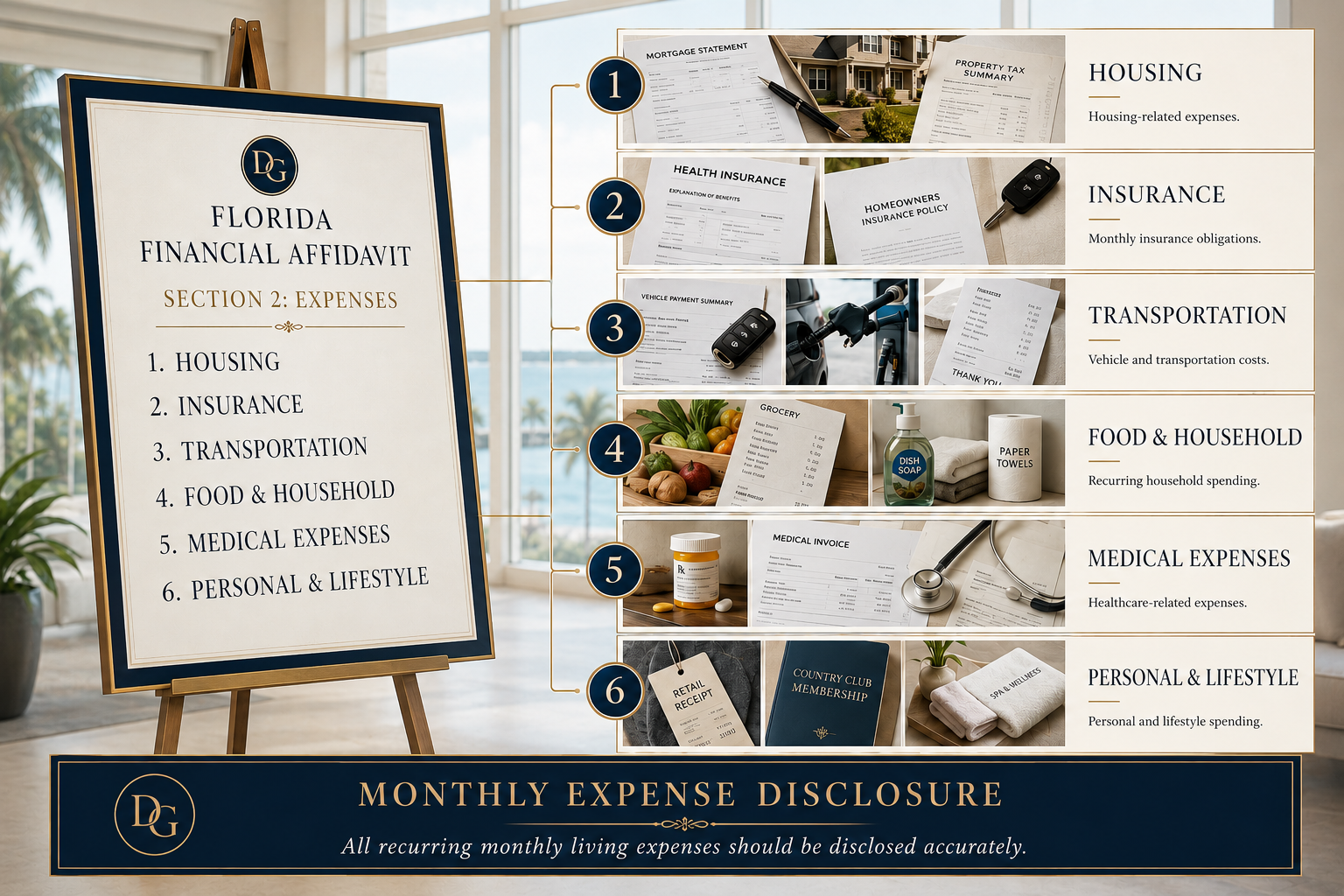
Section 2 in the Florida financial affidavit is EXPENSES. Here, you report your current monthly expenses under different categories. If you don't know an exact amount, use a reasonable estimate based on the information available.
- Household
- Automobile
- Expenses for children common to both parties
- Expenses for children from another relationship
- Other expenses
- Payments to Creditors
- Summary
In Summary, you deduct TOTAL MONTHLY EXPENSES from TOTAL MONTHLY NET INCOME. As a result, you either have a SURPLUS or DEFICIT. Think of this summary as a snapshot of your monthly budget.
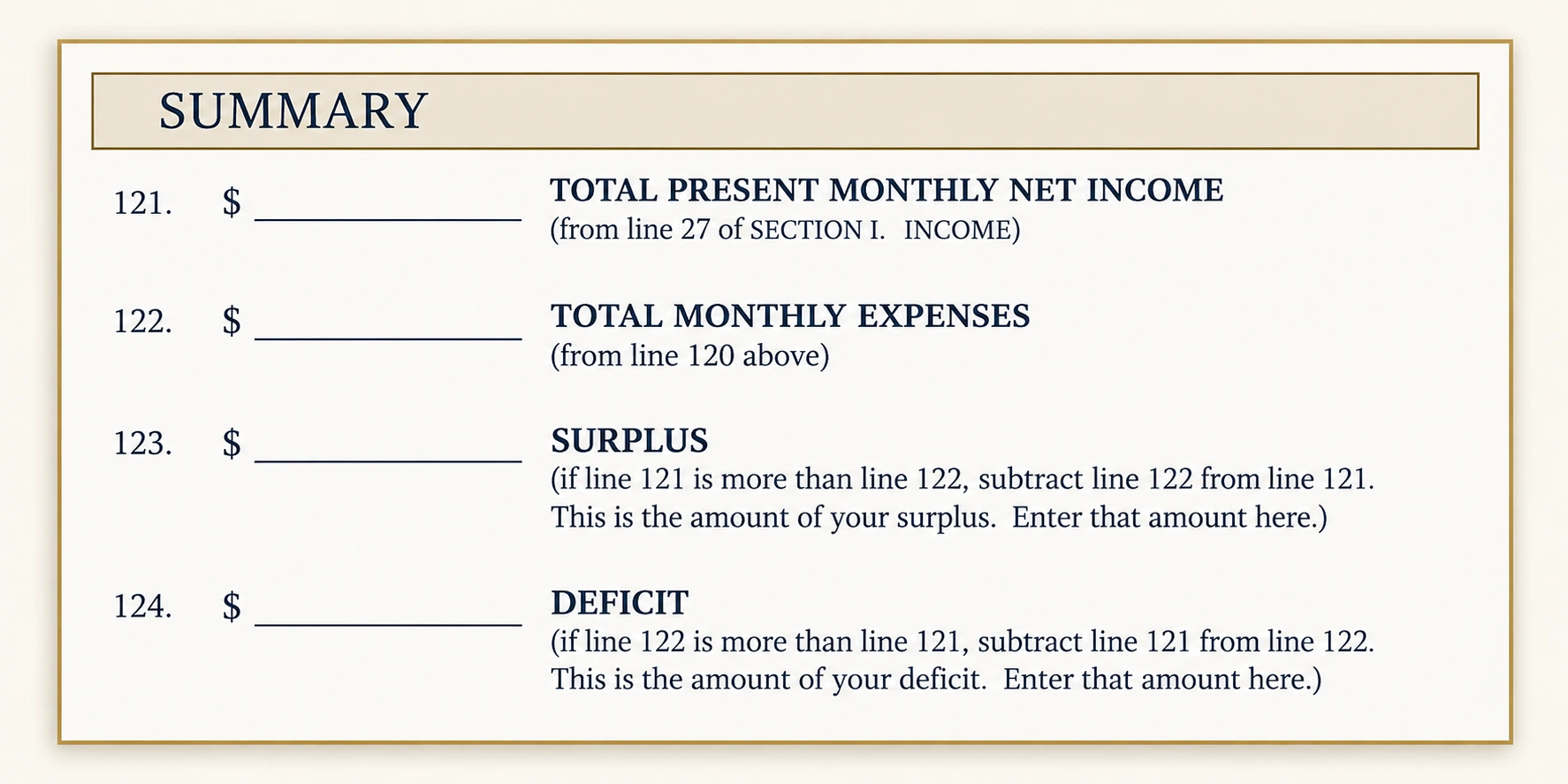
Monthly income, expenses, and surplus or deficit. Illustrative excerpt—not an official court form.
If you don't see a type of expense on the list, add it to "Other." Go through all your statements, and don't skip any entry.
PRO TIP: If health insurance premiums are deducted from your paycheck, report them in the appropriate deductions section. If you pay additional premiums directly, include those expenses separately. Be careful not to subtract the same payment twice when evaluating your monthly budget.
On line 65, "Life Insurance," enter the accumulated cash value in the policy if you have so-called "permanent" insurance. This is NOT the death benefit or face value.
Remember that only "whole life" type policies have cash value. For term policies, this entry will always be ZERO.
Also, be sure that you convert quarterly or annual expenses into monthly. Remember that in Florida's financial affidavit, you should use monthly income and expense amounts.
Next, if the household expenses don't reflect what you actually pay currently, write "estimate" next to each estimated amount.
Your information will likely be your best guess if you don't have access to your family's budget and bank statements.
PRO TIP: For your record, assign your expenses as either "fixed" or "variable." Fixed is when your bill stays the same, and it is mandatory--mortgage, rent, electricity. Variable expense is at your discretion and can vary. It will help you to make potential adjustments to your lifestyle.
But wait! There is more...
Affidavit Section 3: Assets and Liabilities

Well, it is more...
Section 3 of the Florida financial affidavit—ASSETS and LIABILITIES—is the largest coin in your treasure chest. Let's look at its two main parts.
A. Assets
Here, you identify your assets and report their current fair market values, including assets you believe are nonmarital:
Cash, stocks, bonds, notes, money owed
Real estate
Business interests
Automobiles, boats, furniture, collectibles, jewelry, equipment
401k and IRA accounts
Pension
Cash surrender value of life insurance policies, if applicable.
For each sub-section, the form shows three columns:
- A - Description of items
- B - Current fair Market Value
- C - Nonmarital designation (Petitioner or Respondent)
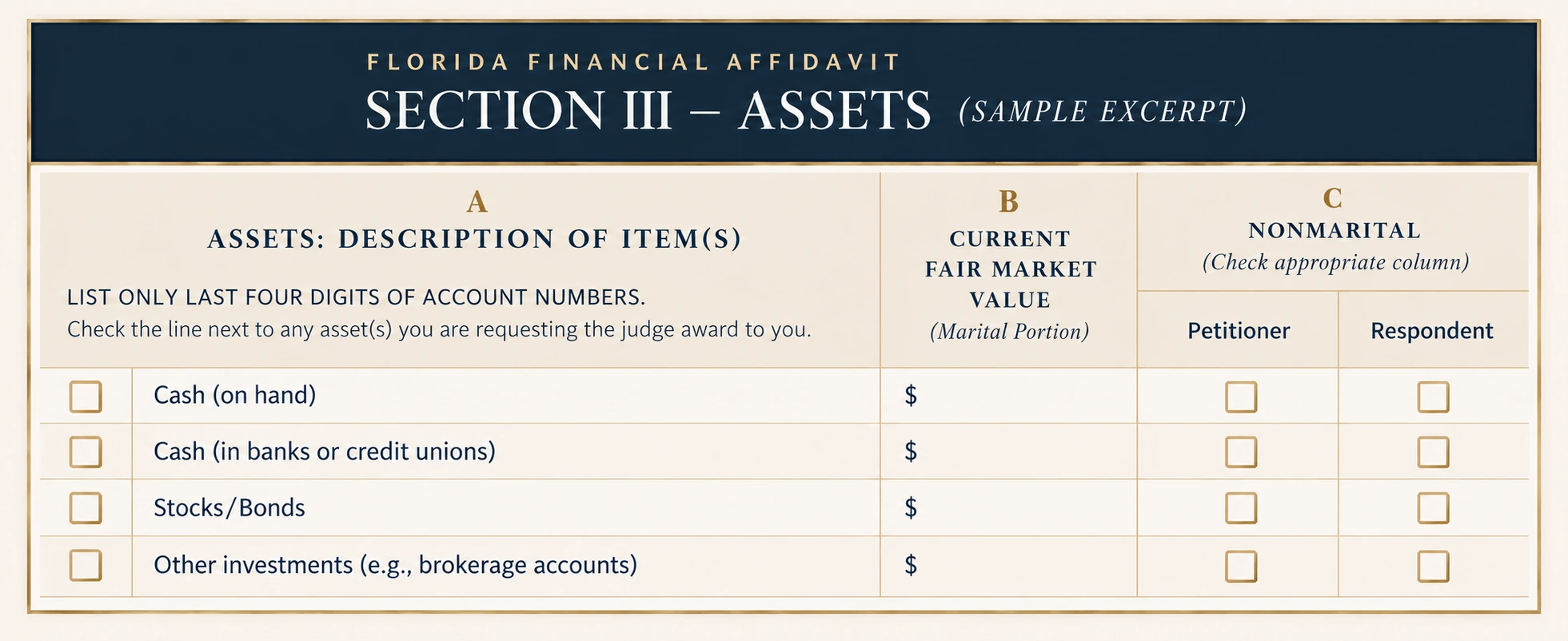
Illustrative excerpt of the Florida Financial Affidavit assets table. Not an official court form.
To complete the form, follow the steps below:
Column A
List a SHORT description of each item owned by you. Use additional lines or an attachment if you need more space.
Column A
Check the line next to any item you request the judge to award to you.
Column B
Enter the current fair market value of the marital portion of each asset. If an asset is partly marital and partly nonmarital, report the respective values in Columns B and C.
Column C
Check the appropriate box under Petitioner or Respondent if you believe an asset is nonmarital. Enter the current fair market value of the nonmarital portion.
PRO TIP: Pay attention to the valuation date. Asset values can change, and the date used may affect how much of an asset is considered marital or nonmarital.
B. Liabilities
Here, you identify debts owed by you or your spouse and report the current amounts owed.
Mortgages
Credit card accounts
Auto loan
Bank/credit union loan
Judgments
Please follow the same steps as above.
 Never include a full bank or credit card account number. Use only the last four digits.
If a debt is partly marital and partly nonmarital, report the marital portion in Column B and the nonmarital portion in Column C.
- Example: if a $3,000 debt includes $2,000 in marital debt and $1,000 in nonmarital debt, enter $2,000 in Column B and $1,000 in the appropriate part of Column C.
Section III also includes C. Net Worth, D. Contingent Assets and Liabilities, and E. Child Support Guidelines Worksheet Information.
What else is left?
Affidavit: How Much Are You Worth?

Net Worth and Declaration
Now, it is time to answer the question, "How much are you worth?"
To do it, you subtract your total liabilities from your total assets. In other words, that's your net worth.
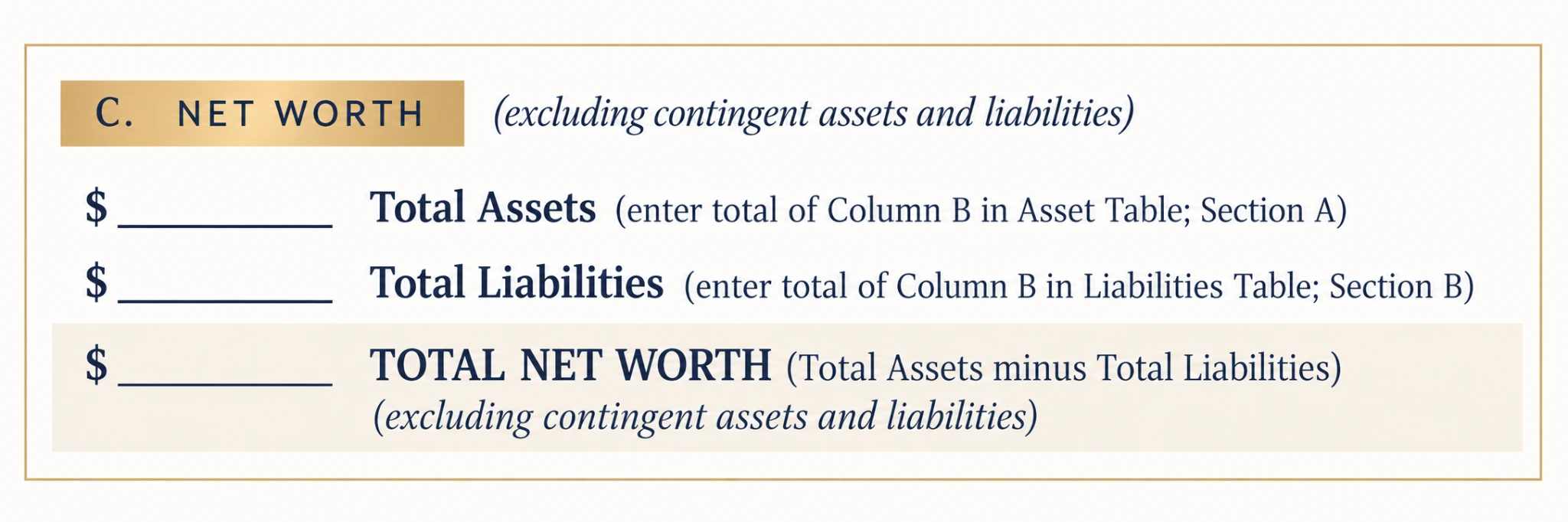
Illustrative excerpt of the Florida Financial Affidavit net worth calculation. Not an official court form.
Be sure to include all assets and liabilities required in the affidavit's net worth calculation, excluding contingent assets and liabilities. Missing or incorrect amounts can distort the result and raise questions about your financial disclosures.
The final step is to sign your Florida financial affidavit and declare, under penalties of perjury, that you have read the document and that the facts stated in it are true.
Complete the Certificate of Service to document when and how you provided a copy of your financial affidavit to the other party or their attorney.
- hand delivery
 CONGRATULATIONS!
You have finished your treasure map - your Florida financial affidavit.
And now, are there any questions you have?
Frequently Asked Questions
FAQs
Yes. Getting professional help is especially important if you have complex finances, including:
- Multiple real estate properties
- Rental properties
- Business interests
- Executive compensation, such as stock options or restricted stock units (RSUs)
- An investment portfolio with a nonmarital portion
In addition to legal assistance, a CDFA® (Certified Divorce Financial Analyst®) can help you organize and understand your financial information. CDFAs specialize in the financial aspects of divorce and can help identify issues that may need closer attention.
For legal advice about your financial affidavit, consult a Florida family law attorney.
You can amend your affidavit if you discover an error, omitted information, or new financial information. You might also have your financial numbers changed after filing the initial affidavit. This is no unusual. After separation, both parties often gain a clearer understanding of what it costs to maintain separate households.
Yes. The Florida financial affidavit Form 12.902(c) includes official instructions explaining when to use the form, how to complete it, and important information about filing and service.
Each section also provides instructions for reporting financial information and calculating the required amounts and totals.
You can also visit the self-help center at your county clerk's office for additional resources. And, of course, bookmark this article to use as a reference!
Remember that the financial affidavit is one of the mandatory Florida divorce forms in many divorce proceedings and can significantly affect your case. Knowingly providing false information can lead to serious consequences:
1. LEGAL PENALTIES.
Intentionally providing false information on a sworn financial affidavit may constitute perjury or fraud and can result in legal penalties.
2. NEGATIVE IMPACT ON YOUR CASE.
Courts rely on financial affidavits when deciding issues such as child support, alimony, and property division. False disclosures can damage your credibility and affect the outcome of your case.
Final Thoughts...
Remember our goal?
It is to secure assets in a divorce. How can you do it?
By accurately completing and properly filing your Florida financial affidavit.
Remember that it is not just about numbers and figures. The affidavit also tells your true and honest financial story.
Further, it helps others—your spouse, attorney, and the judge—understand your financial situation. As a result, the court can make more informed decisions that may significantly affect your life and the lives of your loved ones.
Can you afford to mess it up?
In summary:
- Gather all your records and organize financial information.
- Get a copy of the Florida financial affidavit and review it.
- Read all instructions carefully.
- Complete each section and make sure your figures are accurate.
- Use actual figures whenever possible. If necessary, provide reasonable estimates rather than guesses.
- Sign the document and complete the Certificate of Service to document delivery to the other party or their attorney.
- Amend or update the affidavit if you discover an error, omitted information, or a material change in your financial circumstances.
If you have questions about the Florida financial affidavit, consult your attorney or contact us for guidance from a CDFA®.
Your financial future deserves more than guesswork.
For the life you're building,
Nella Zelensky
About the Author
Facing her own divorce, Nella discovered firsthand how overwhelming financial decisions can become—even with a background in finance. That inspired her to focus on divorce financial analysis. Building on an established career in finance, she earned the Certified Divorce Financial Analyst® (CDFA®) designation, followed by the Master Analyst in Financial Forensics® (MAFF®) credential.
Today, as Co-Founder of The Divorced Gals, Nella helps women understand the financial consequences of divorce, ask better questions, and make decisions with greater clarity and confidence.