

I wasn't any better prepared.
When I filed for divorce a few years ago, I trusted my lawyer and, without hesitation, followed his lead. I wish I had understood the legal terminology, the required divorce forms, and the order in which things needed to happen. It would have saved me money and helped me avoid costly mistakes.
Today, as a Certified Divorce Financial Analyst®, I know that even when you work with an attorney, it pays to understand how the divorce process works.
In this article, I'll explain the essential Florida divorce forms, when you may need them, and the common mistakes to avoid.
So, let's dive in...
Florida Divorce Forms: Initial Filing
Before filing for divorce in Florida, you need to meet the state's residency requirement and have legally recognized grounds for divorce.
Residence:
- At least one spouse must have lived in Florida for six months before filing for divorce.
Grounds for Divorce:
- Marriage is irretrievably broken;
- Mental incapacity of one spouse, as determined by a court, for at least three years before filing.
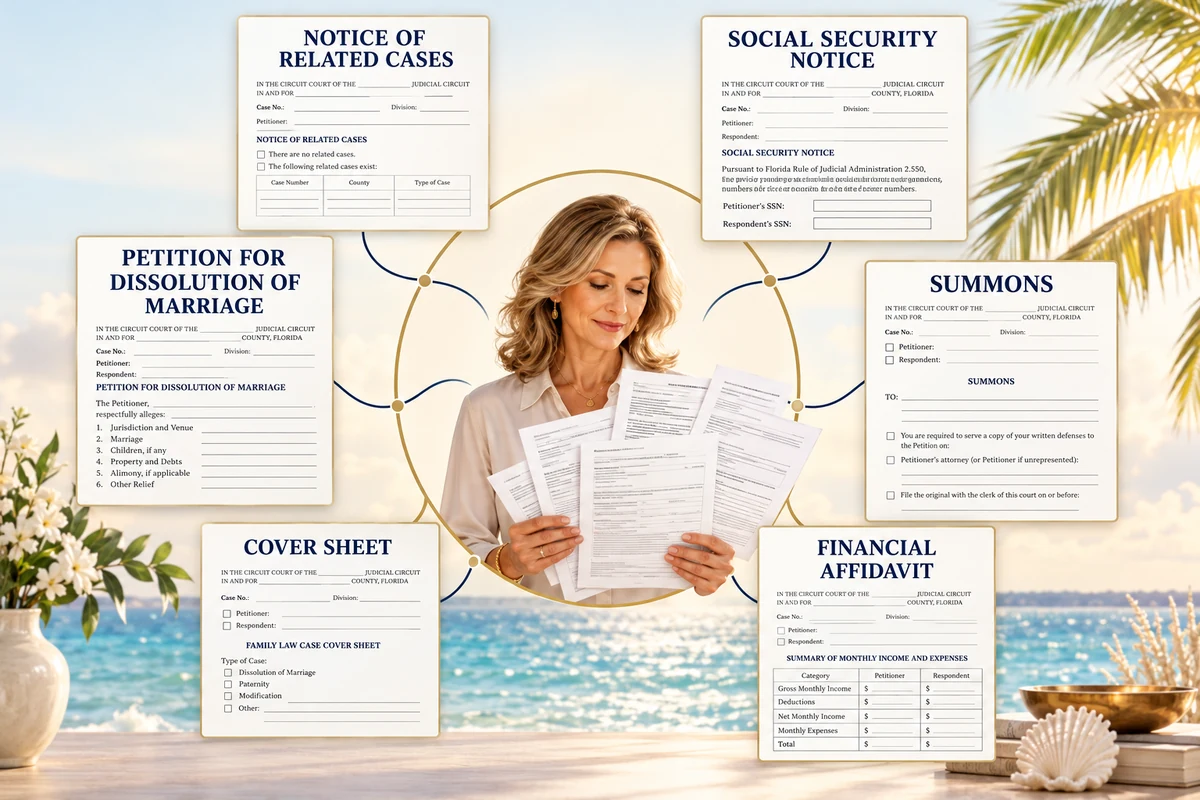
Once you meet these requirements, you can begin the filing process. Here are six important Florida divorce forms you should know about.
Below are mandatory Florida divorce forms.

The Cover Sheet addresses the following:
- Case style (circuit court, county, case number, judge, petitioner, respondent)
- Type of action (initial action, reopening case, or modification)
- Type of case
2. Petition for Dissolution of Marriage

On the Florida Courts website, there are four Petition for Dissolution of Marriage forms depending if you have minor children or property:
- Form 12.901(b)(1) — Petition for Dissolution of Marriage with Dependent or Minor Child(ren).
- Form 12.901(b)(2) — Petition for Dissolution of Marriage with Property but No Dependent or Minor Child(ren).
- Form 12.901(b)(3) — Petition for Dissolution of Marriage with No Dependent or Minor Child(ren) or Property.
- Form 12.901(a) — Joint Petition for Simplified Dissolution of Marriage.
In general, depending on the type of petition, you may need to provide information about:
- Residency of the spouses
- Military service of either spouse
- Marriage history
- Dependent or minor children
- Child support, if applicable
- Parental responsibility and time-sharing
- Alimony, if requested
- Marital assets and liabilities

This form tells the court whether there are other cases connected to your divorce, such as child support, domestic violence, or paternity proceedings.
- You are already separated and filed for child support
- Pending bankruptcy case
- Domestic violence injunction
- Adoption/Paternity

This form provides Social Security number information required by the court. It is treated as confidential information and is not intended for public access."

The summons formally notifies your spouse that a divorce case has been filed and explains the deadline for responding. Service must follow Florida's legal requirements.
6. Financial Affidavit - Short Form 902(b), long Form 902(c)

In most Florida divorce cases, both spouses must complete a Financial Affidavit disclosing their income, expenses, assets, and liabilities. This information helps the court evaluate financial issues, including child support and alimony when applicable.
PRO TIP 1: Gather and organize your financial records before completing the Financial Affidavit. Keep copies of your supporting documents.
If you file for a divorce without an attorney, check below a video training on how to file a new case on Florida Courts E-Filing Portal.
Local Forms
In addition to Florida Supreme Court-approved forms, your county may require local forms or additional filing documents. Check with your circuit court clerk before filing.
PRO TIP 2: Review the official Florida divorce forms and their instructions before completing them. Make sure you understand which forms apply to your situation.
PRO TIP 3: Be thorough. Incomplete or inaccurate forms can delay your divorce and create problems later.
Simplified Dissolution of Marriage Form
Are you and your spouse amicable?
If you both agree on the terms of your divorce, you may qualify for an uncontested divorce.
But Florida offers another option for couples who meet specific requirements: a simplified dissolution of marriage.
This process uses the Petition for Simplified Dissolution of Marriage (Florida Supreme Court Approved Family Law Form 12.901(a)) and allows eligible couples to file jointly.
To qualify for a simplified divorce in Florida, you and your spouse must meet all of these requirements:
- At least one spouse has lived in Florida for six months before filing.
- You both agree that the marriage cannot be saved.
- You have no minor or dependent children together, and the wife has no minor or dependent children born during the marriage.
- The wife is not pregnant.
- You agree on how to divide your assets and debts.
- Neither spouse is seeking alimony.
- You both agree to give up your rights to a trial and appeal.
- You both sign the joint petition and agree to attend the final hearing together.
Simplified Divorce Case Study
Let's look at Mike and Sarah.
They have been married for three years and have mutually decided to end their marriage. They want to keep the process as straightforward as possible and avoid unnecessary complications.
Mike and Sarah meet Florida's simplified divorce requirements. Here's how their divorce process works:
1. Preparing the Joint Petition
Mike and Sarah complete and sign the Joint Petition for Simplified Dissolution of Marriage. They provide information about their marriage and confirm that they agree on dividing their assets and debts.
2. Filing the Paperwork
They file their joint petition and other required documents with the clerk of the circuit court in the county where they live. They also provide proof that at least one of them meets Florida's six-month residency requirement.
Because they file jointly, neither spouse needs to serve the other with divorce papers.
3. Preparing for the Final Hearing
Mike and Sarah follow their county's procedures for scheduling the final hearing. They make sure their paperwork is complete and prepare any documents the court requires.
4. Attending the Final Hearing
Mike and Sarah appear together at the final hearing. The judge reviews their paperwork and determines whether they meet the requirements for a simplified divorce.
5. Receiving the Final Judgment
If everything is in order, the judge may sign the Final Judgment of Simplified Dissolution of Marriage.
Once the judge signs the final judgment, Mike and Sarah are legally divorced!
PRO TIP 4: In a Florida simplified divorce, both spouses agree to give up their right to a trial and appeal. Make sure you understand what you're giving up before signing the joint petition.
Next, do you have minor children?
Filing for Divorce in Florida with a Child

Where have your children lived during the past five years, and who have they lived with?
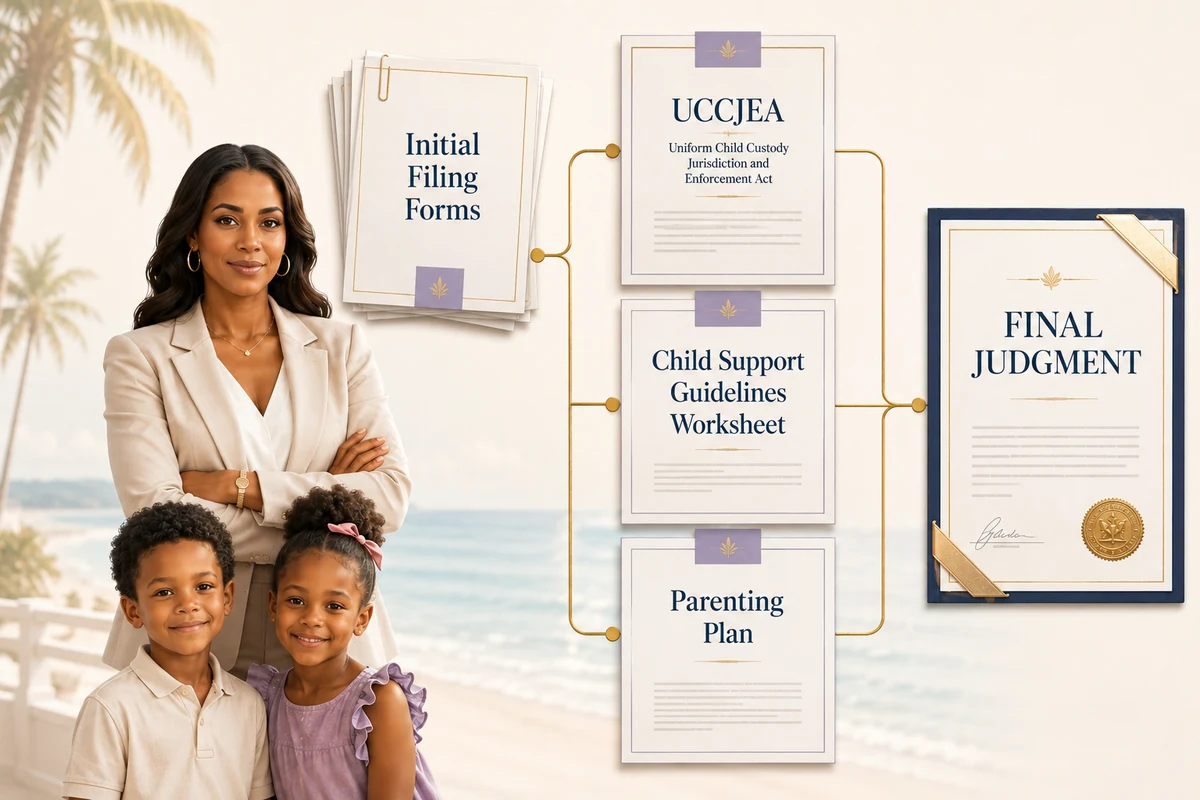
That's what the Uniform Child Custody Jurisdiction and Enforcement Act (UCCJEA) Affidavit asks you to explain. You'll also need to disclose any other custody or time-sharing cases involving your children.
Why does this matter? The court needs to determine which state has the authority to make decisions about your children.
And yes, you'll need this form even if you and your spouse agree on parenting arrangements.

How much child support should each parent contribute?
Florida uses child support guidelines under Florida Statute §61.30 to help answer that question. The calculation starts with both parents' combined net income and the number of children.
But income isn't the whole picture. The calculation also considers:
Health insurance costs for the children
Work-related childcare expenses
How many overnights the children spend with each parent
The Child Support Guidelines Worksheet helps you put these numbers together and estimate the support obligation.
You can use this Florida child support calculator to get an estimate.

How will you and your spouse share parenting responsibilities after divorce?
A Parenting Plan explains how you'll make important decisions about your children, where they'll spend their time, and how you'll handle everyday arrangements such as holidays, school schedules, and communication.
Even if you agree on everything, you'll generally need a Parenting Plan approved by the court.
PRO TIP 5: Don't assume you can wait until the final hearing to submit your Child Support Guidelines Worksheet or Parenting Plan. Florida has specific filing requirements, and your county may have additional procedures. Check the applicable deadlines before filing.
Asking for a Child Support: What You Should Know
When filing for divorce with minor children, your petition should address child support, including who will provide health insurance and how you'll divide uncovered medical expenses.
But what if you and your spouse agree that neither of you needs to pay child support?
The court still needs to address child support, even when both parents agree.
Why?
Because child support is intended for your children, not simply for either parent. You cannot permanently waive your children's right to support through a private agreement.
Depending on the circumstances, a court may approve a support amount of zero or reserve the issue for a later decision. But that requires appropriate legal grounds and court approval—not just an agreement between parents.
PRO TIP 6: If circumstances change, parents can modify child support before a minor reaches 18.
Respondent's Answer
10. Respondent's Answer
Once you file your divorce petition, the next step is generally to formally serve your spouse with the divorce papers.
Your spouse, now called the respondent, typically has 20 days after being served to file an Answer with the court.
But what happens during those 20 days?
Your spouse can file an Answer to your divorce petition, agreeing or disagreeing with your requests. They may also file a counterpetition if they want to make their own requests.

They may need to submit additional documents, including a Financial Affidavit.
Florida Divorce Process 20 Day Rule
Florida has different Answer forms depending on your circumstances, including whether you have minor children or property to divide.
The Answer lets your spouse tell the court what they agree with, what they dispute, or what they don't have enough information to answer.
The respondent must also confirm when and how they provided a copy of the Answer to the other spouse, using an approved delivery method.
A Financial Affidavit generally has a separate filing deadline, so it doesn't necessarily have to accompany the Answer.
What if your spouse agrees with everything?
They may be able to file an Answer and Waiver, agreeing to the petition and waiving notice of the final hearing. They should understand which rights they're giving up before signing.
PRO TIP 7: You can dispute statements or requests in an Answer. But if you sign an Answer and Waiver, you're agreeing to the petition and waiving certain rights, including notice of the final hearing. Make sure you understand those rights before signing.
PRO TIP 8: If your spouse hasn't filed an Answer or appeared in the case, you generally need to file an Affidavit of Military Service before the court can enter a default judgment. This helps protect the legal rights of spouses serving in the military.
But wait! There is more...
Final Judgment of Dissolution of Marriage
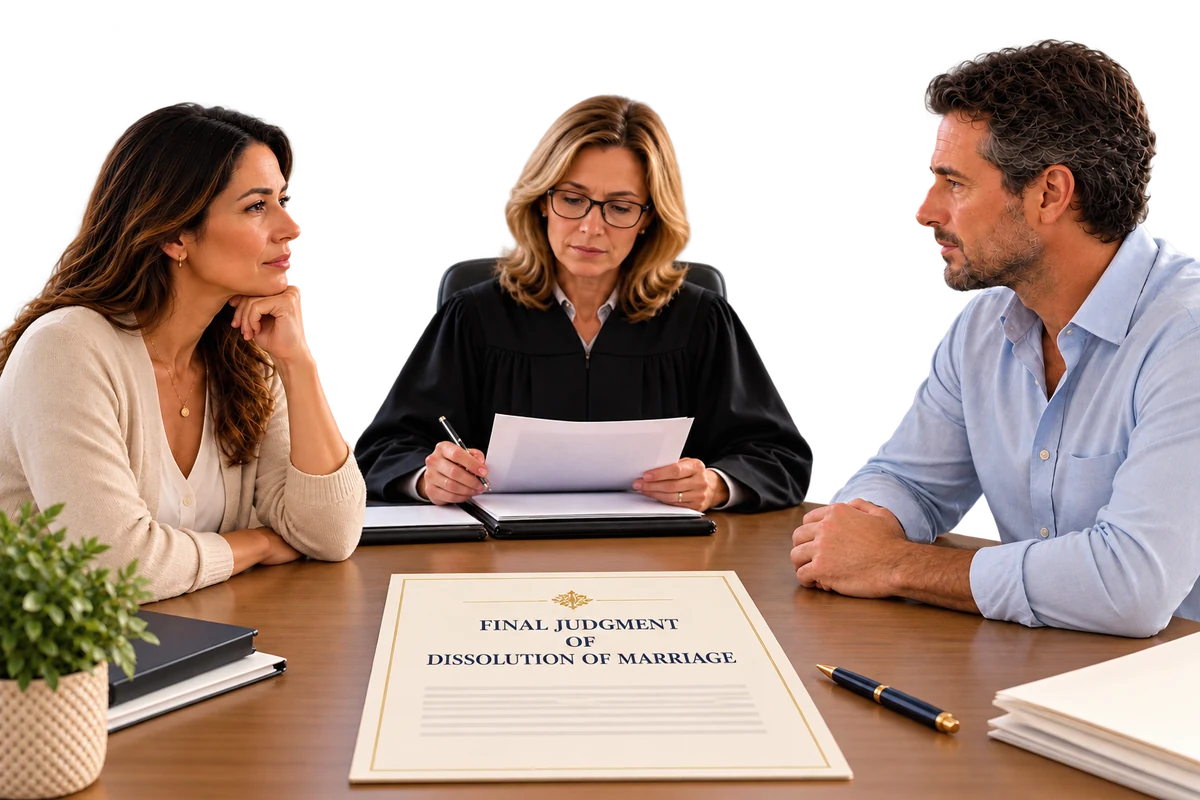
The final step before you can say, "I am divorced!" is a Final Judgment of Dissolution of Marriage. It is a legally binding document issued by the family court and officially terminates your marriage.
The final judgment has significant consequences.
Regardless, if you have an attorney or filed for a divorce without an attorney, be aware of the 7 critical elements of the Final Judgment of Dissolution of Marriage:
1.
Identification of Parties:
It includes spouses' legal names and any known aliases.
2.
Termination of Marriage:
The final judgment indicates the ending of the spouses' marital relationship.
3.
Division of Property and Debts:
This section outlines how real estate, financial accounts, personal property, and marital debts are divided, whether by agreement or court decision.
4.
Alimony (Spousal Support):
The judgment may state the amount, terms, and duration if there is alimony. In a simplified divorce, neither spouse can seek alimony.
5.
Child Custody and Support:
If you have minor or dependent children, the final judgment addresses parental responsibility, time-sharing, and child support. Also, it outlines the parenting plan and any additional financial obligations related to a child's well-being.
6.
Name Change (If applicable):
If you or your spouse requested a name change as part of a divorce, the final judgment may include the approved name change.
7.
Other Provisions:
The final judgment may also include other provisions related to your divorce, such as:
- restraining order
- return of personal property
- any other specific agreements
PRO TIP 9: Carefully review your Final Judgment of Dissolution of Marriage before it's entered by the court. Make sure it reflects your settlement agreement or the judge's decisions and protects your rights and interests.
One more thing...
Common Mistakes When Completing Florida Divorce Forms
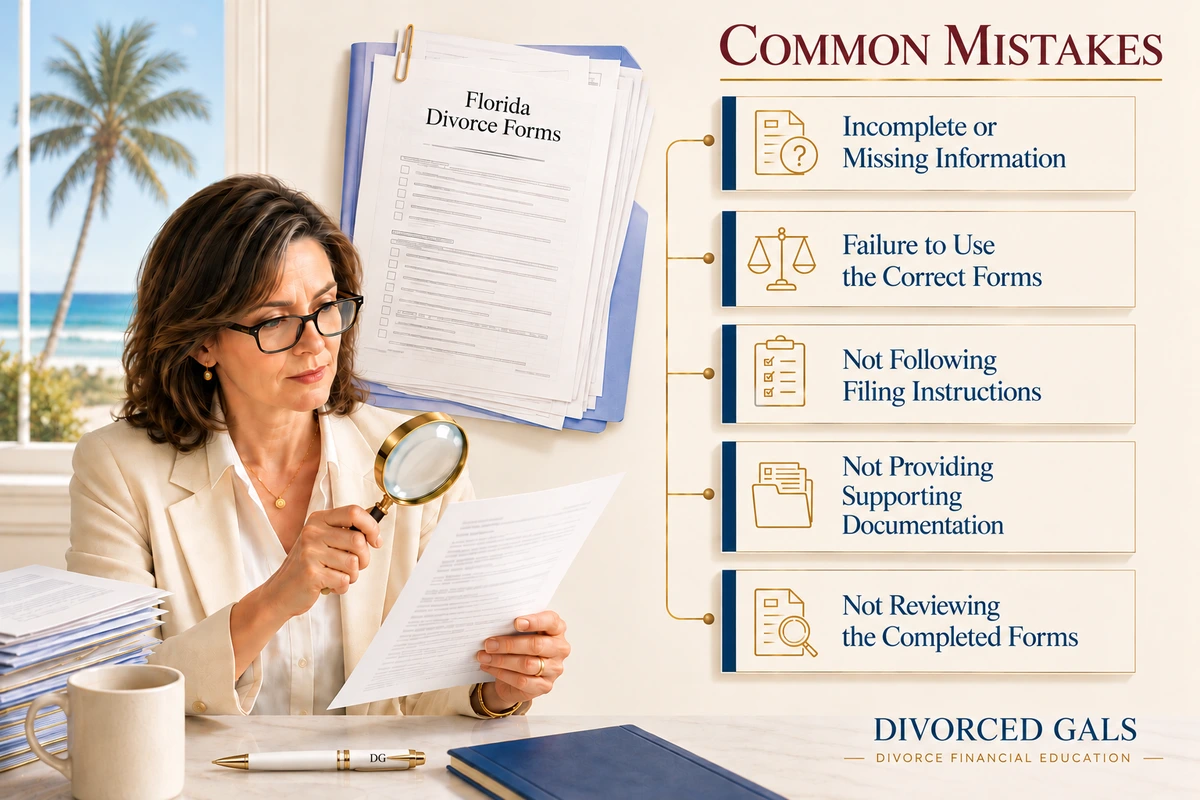
Want to avoid complications and lengthy court proceedings?
I need to warn you about the most common mistakes I see when helping clients as a divorce financial expert, especially with Financial Affidavits. These mistakes can delay your divorce or lead to outcomes you didn't expect.
1. Incomplete or Missing Information
Failing to provide all the necessary information in your Florida divorce forms can lead to delays or rejection. Read the instructions carefully and complete each required section.
2. Incorrect or Inconsistent Information
Make sure your information is consistent throughout your Florida divorce forms. Otherwise, discrepancies may raise questions and lead to further complications.
3. Failure to Follow Filing Instructions
Be sure to follow the instructions for each form. Pay attention to formatting requirements, signatures, supporting documents, and filing deadlines.
4. Not Providing Required Documents
Some Florida divorce forms require supporting documents, such as financial statements, parenting plans, or property inventories. Make sure you provide everything required to avoid unnecessary delays.
5. Not Reviewing the Completed Forms
Before submitting your Florida divorce forms, review them carefully for mistakes or missing information.
6. Failure to Use the Correct Forms
Are you using the most up-to-date Florida divorce forms? Check the official Florida Courts website or consult an attorney. For local forms, visit your county clerk's website.
7. Ignoring the Need for Professional Advice
Yes, you can complete your Florida divorce forms without an attorney. However, legal guidance can help protect your rights and interests, especially if your case is more complex.
PRO TIP 10: While completing Florida divorce forms, consider the future. It is crucial to think about the long-term implications of the decisions you make today.
FAQs: Frequently Asked Questions
The easiest way to get a divorce in Florida is usually through an uncontested divorce, where both spouses agree on major issues, including the division of assets and debts, alimony, and child support, if applicable.
If you meet the eligibility requirements, a Simplified Dissolution of Marriage may be an even easier option.
You can get Florida divorce forms online through the Florida Courts website. You can also obtain them from your county's Clerk of the Circuit Court, either at the clerk's office or through its website.
You can file your completed Florida divorce forms with the Clerk of the Circuit Court in the appropriate county, either in person at the clerk's office or online through the E-Filing Portal.
The cost of filing for divorce in Florida without an attorney depends on the county where you file and any additional services your case may require.
Filing/Service of Process Fees
For example, the filing fee to initiate a divorce in Palm Beach County is $409.00. The Clerk also charges $10.00 to issue a summons if one is required. You may have additional costs for serving your spouse and processing electronic payments.
Check your county clerk's website for current fees.
Professional Fees
If you hire an attorney or other professionals, such as a Certified Divorce Financial Analyst® or CPA, their fees can vary widely depending on their experience and the complexity of your case.
Additional Costs
Depending on your situation, you may also have expenses for:
Mediation
Court-required parenting classes
Expert witnesses, if needed
Other services or requirements specific to your case
If your spouse doesn't respond within 20 days after being properly served, you can file a Motion for Default and ask the clerk to enter a Clerk's Default. This means your spouse has failed to respond to the divorce petition.
But a default doesn't automatically mean you've won your case. You still need to complete the required paperwork and, generally, attend a final hearing. The judge will review your case and decide issues such as property division, parental responsibility, child support, and alimony, as applicable.
Keep in mind that the procedures may differ depending on your circumstances, especially if your spouse has already filed documents or was served by publication.
Before completing your Florida divorce forms, remember that Florida is a no-fault divorce state. You don't have to prove that your spouse did anything wrong.
Under Florida Statute §61.052, there are two grounds for divorce:
The marriage is irretrievably broken.
One spouse has been declared mentally incapacitated under Florida law for at least three years before filing the divorce petition.
Yes. At least one spouse must have lived in Florida for six months before filing the divorce petition, as required by Florida Statute §61.021.
In Summary...
I hope I've helped you demystify the essential Florida divorce forms. Of course, your specific situation might require additional paperwork and administrative steps. Use this article as a reference.
Remember my friend Marsha?
She made mistakes with her Florida divorce forms and needed an attorney to get her back on track and help her navigate the divorce process.
Remember, mistakes can do more than delay your divorce or get your paperwork rejected. They can also have legal and financial consequences, not to mention more stress, time, and money.
Is it worth it?
So, be smart and don't repeat Marsha's mistakes.
If you're filing for divorce, treat it as serious business. At a minimum, take the time to understand the essential Florida divorce forms.
And remember: YOU ONLY HAVE ONE CHANCE TO GET IT RIGHT!
For the life you're building,
Nella Zelensky
About the Author
Facing her own divorce, Nella discovered firsthand how overwhelming financial decisions can become—even with a background in finance. That experience inspired her to focus on divorce financial analysis. Building on an established career in finance, she earned the Certified Divorce Financial Analyst® (CDFA®) designation, followed by the Master Analyst in Financial Forensics® (MAFF®) credential.
Today, as Co-Founder of The Divorced Gals, Nella helps women understand the financial consequences of divorce, ask better questions, and make decisions with greater clarity and confidence.