


When a divorce settlement is signed, you focus on what has been divided. But financial planning after divorce ask different set of questions.
The house.
The retirement accounts.
The investment portfolio.
Cash.
Perhaps a business interest.
The settlement marks the legal end of one chapter and, after months—or even years—of uncertainty, can bring a welcome sense of closure.
But every divorce transfers something else.
It transfers responsibility.
Financial planning after divorce begins with understanding what now belongs to you, asking better questions, and becoming an active participant in the decisions that shape your future.
The settlement may have concluded your divorce. But there are still important financial decisions ahead.
And here's where things get interesting...
The Day Everything Becomes Your Responsibility

Every marriage develops its own division of responsibilities.
Maybe your husband managed the investments while you handled the household finances. Maybe one of you focused on the business while the other kept everything at home running. Or maybe you made most financial decisions together.
Whatever the arrangement, there was a "we."
Then one day, there isn't.
And that's when something changes that no settlement agreement can fully capture. Decisions that once belonged to both of you—or perhaps mostly to your ex—now belong to you. Not because you suddenly know more than you did yesterday. Simply because they're yours to make.
And that's the strange part. The responsibility comes before you feel ready for it.
Think of financial planning after divorce as stepping into a new role: the CEO of your own financial life.
That may sound a little corporate. But think about what a good CEO actually does.
She doesn't know everything. She doesn't try to.
She understands what she's responsible for. She asks questions. She surrounds herself with people who know things she doesn't. And when an important decision reaches her desk, she makes sure she understands it before saying yes.
Not becoming an investment expert. Not learning the tax code. Not pretending you understand something when you don't.
It's becoming comfortable saying:
"This is my decision. Help me understand it."
That shift doesn't happen the day your divorce becomes final. It's a gradual part of financial planning after divorce.
So where do you begin?
By moving from:
"What did I receive?"
to:
"What does it mean for my life now?"
Financial Planning After Divorce: Beyond the Settlement

01
Divorce Settlement
What you received

02
Understanding
What does it mean for my life now?

03
Questions
Income · House · Investments · Taxes · Risk

04
Decisions
What should I do?

05
Your Financial Life
One decision at a time
After months of gathering financial records, completing affidavits, answering discovery requests, reviewing accounts, valuing property, and negotiating a settlement, you might reasonably think:
Haven't we already figured all of this out?
In one sense, yes. The divorce process had an important job to do.
- What assets exist?
- What are they worth?
- What do we owe?
- How should everything be divided?
Those questions had to be answered before an agreement could be reached.
But here's the distinction that matters now. Your settlement tells you what you have. Financial planning after divorce helps you determine what to do with it.
Think of it as an inventory.
You may now have a house, investment accounts, retirement assets, cash, support income, or even a business interest. That's valuable information.
But an inventory is still just an inventory.
It doesn't tell you whether keeping the house makes financial sense five years from now. It doesn't tell you how much income your investments can reasonably provide.
It doesn't tell you how taxes, healthcare costs, inflation, or market changes may affect the lifestyle you're trying to maintain. And it can't tell you which decisions you'll need to reconsider as your life changes.
That's not because something was missed during the divorce. It simply wasn't the settlement's job.
The settlement answered one set of questions.
Financial planning after divorce addresses another.
And those questions sound very different...
The Questions That Begin After the Settlement Ends
So, what does financial planning after divorce actually look like?
It may start with surprisingly simple questions.
That last question can be surprisingly difficult to ask.
Consider this.
A major medical procedure? Most of us wouldn't hesitate to get a second opinion.
A kitchen renovation? We're probably getting more than one estimate.
And finding the right hairstylist? Some of us have conducted what could reasonably qualify as due diligence.
But money?
Somehow, we become much more hesitant.
Perhaps the financial advisor has worked with your family for years. Maybe your former husband originally chose the relationship. Maybe you genuinely like and trust the advisor.
There may be absolutely no reason to make a change.
But there's also nothing wrong with asking questions—or hearing another perspective. If you're not sure where to begin, the SEC offers a helpful list of questions to ask your financial professional.
Can your advisor explain the strategy in language you understand? Does it reflect what you need now?
Do you feel comfortable saying, "I don't understand. Can you explain that differently?"
And if you wanted another opinion, would you know where to get one?
A second opinion isn't a vote of no confidence. Sometimes it's simply another way to understand your options before making an important decision.
And once you start asking questions like these, something else becomes clear:
None of these questions exist in isolation.
Income affects lifestyle.
Lifestyle affects taxes.
Risk affects both.
And that's where the questions start getting really interesting.
A FRESH PERSPECTIVE
Sometimes a second look
changes what you see
If you have questions about what your settlement means for the life ahead, we can help you take a closer look.

The Questions That Shape What Comes Next
So, what happens when you start connecting those questions?
Take income, for example.
After divorce, one of the most important questions may be surprisingly simple:
"Where will my income come from now?"
You may have investment accounts, retirement assets, cash, or other property. But substantial assets don't automatically mean dependable income.
Which investments produce income? Which are for long-term growth? How much income can they reasonably provide? And at what risk?
Then another question follows:
Who is helping you make those decisions?
Maybe it's the same advisor your family used during the marriage. That may be exactly the right person. Or maybe not.
The point isn't to change advisors because your marriage ended. It's to make sure the relationship still works for you.
Can your advisor clearly explain what your portfolio is designed to do? Do you understand what's in it—and why? And what are you paying for?
Yes, fees and performance are important. But without understanding the risk, you're missing part of the picture.
Think about two drivers heading to the same destination. One stays in the middle lane and drives at a comfortable speed. The other drives in the fast lane, going much faster and taking more risk.
They may arrive at the same place. But they took very different risks getting there.
Investment returns can work the same way.
In financial planning after divorce, income is only one part of the picture.
How much you need depends on how you live. How much you keep depends partly on taxes. And today's choices can affect the options you have years from now.
That's why, in financial planning after divorce, one question so often leads to another.
The common thread in all these decisions? YOU.
Confidence Grows When You Get Involved
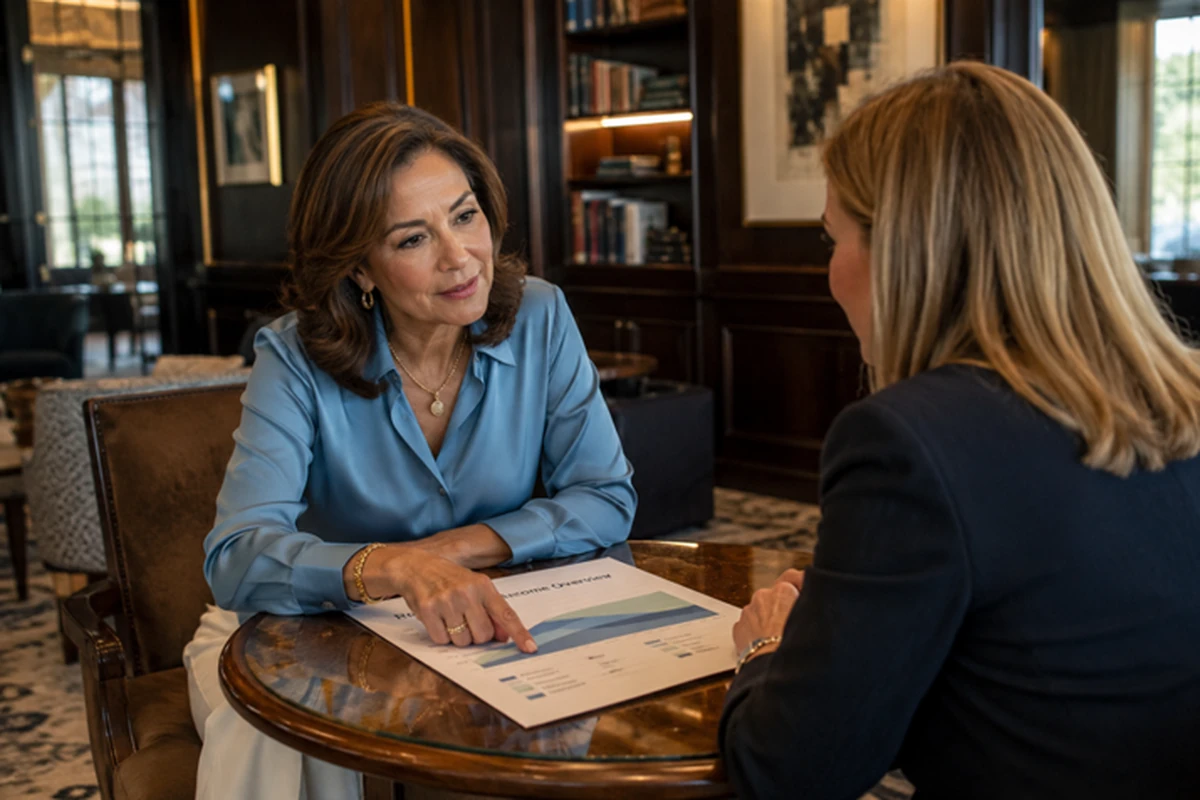
And as your questions begin to change, something else starts to change too: the way you take part in the conversation.
You begin to understand more. And the more you understand, the easier it becomes to get involved.
That's where confidence starts to grow.
We often imagine it happening the other way around.
First, I'll feel confident.
Then I'll ask questions.
Then I'll make decisions.
But confidence in financial planning after divorce rarely comes first.
It grows as you start making those decisions for yourself.
You ask a question. You hear the answer. Maybe you understand it. Maybe you don't.
So you ask another question.
You're no longer sitting quietly while someone explains what should happen with your money.
You're part of the discussion.
And little by little, the conversation starts to feel different.
Financial planning after divorce doesn't mean doing everything on your own. In fact, good professionals can become even more valuable as your questions become better.
But the relationship changes.
What matters is understanding enough to be involved in the financial decisions that affect your life after divorce.
And over time, something else changes too.
The questions that once felt uncomfortable become easier to ask. The decisions that once felt intimidating become easier to understand.
Not because you've become an expert.
Because you've become involved.
YOUR NEXT CHAPTER
A Fresh Start.
On Your Terms.
Your divorce is final. Now it's time to focus on the life ahead—with clarity, confidence, and a fresh perspective.

Frequently Asked Questions
A divorce settlement establishes how assets, debts, and financial obligations are divided or addressed between spouses. That's an important accomplishment, but it serves a different purpose from financial planning after divorce. Even a carefully negotiated settlement cannot determine how you'll manage your money, make investment decisions, or adapt to changing circumstances in the years ahead.
Financial planning after divorce marks a shift from dividing finances to managing them. You may need to make decisions about spending, saving, investments, housing, retirement, and future income. These aren't necessarily unfinished divorce matters. They're the ongoing financial decisions that come with building your next chapter.
Your priorities may shift as you become more involved in financial planning after divorce. Income needs, lifestyle preferences, investment risk, retirement goals, and financial flexibility can take on new meaning. Some priorities may remain exactly the same. Others may evolve as you gain a clearer picture of what matters most to you.
Confidence in financial planning after divorce develops through participation, not perfection. Ask questions, understand your options, and take an active role in decisions affecting your money. You don't need to become a financial expert overnight. Over time, making informed decisions and staying involved can help you feel more comfortable directing your financial future.
The Settlement Was the Beginning
And that's how your financial life gradually begins to feel like your own.
Not because you suddenly have every answer.
But because you're asking questions, understanding more, and becoming more comfortable making decisions for yourself.
You won't get every decision perfectly right.
No one does.
What matters is that you stay involved. That you understand what you're agreeing to. And that you keep asking when something doesn't make sense.
Over time, those moments add up.
Not just to greater financial confidence.
But to something even more important:
A financial life that's truly your own.
It won't happen all at once.
Financial planning after divorce isn't about making one big decision.
It's about moving forward, one small decision at a time.
Barry Giske
About the Author, Barry Giske
For Barry, it all started by accident...
Before the divorce advisory business, Barry worked hands-on in five critical areas: TITLE, MORTGAGE, REAL ESTATE, WEALTH MANAGEMENT, and INSURANCE. One day, his wealth management client--a family law attorney--asked Barry to talk to one of his divorce clients. She worries about future income, mortgage refinancing, re-titling her real estate properties, and insurance planning. Those are the areas where most divorcees face costly pitfalls. And this was where all of Barry's experience came into play.